
Quick answer
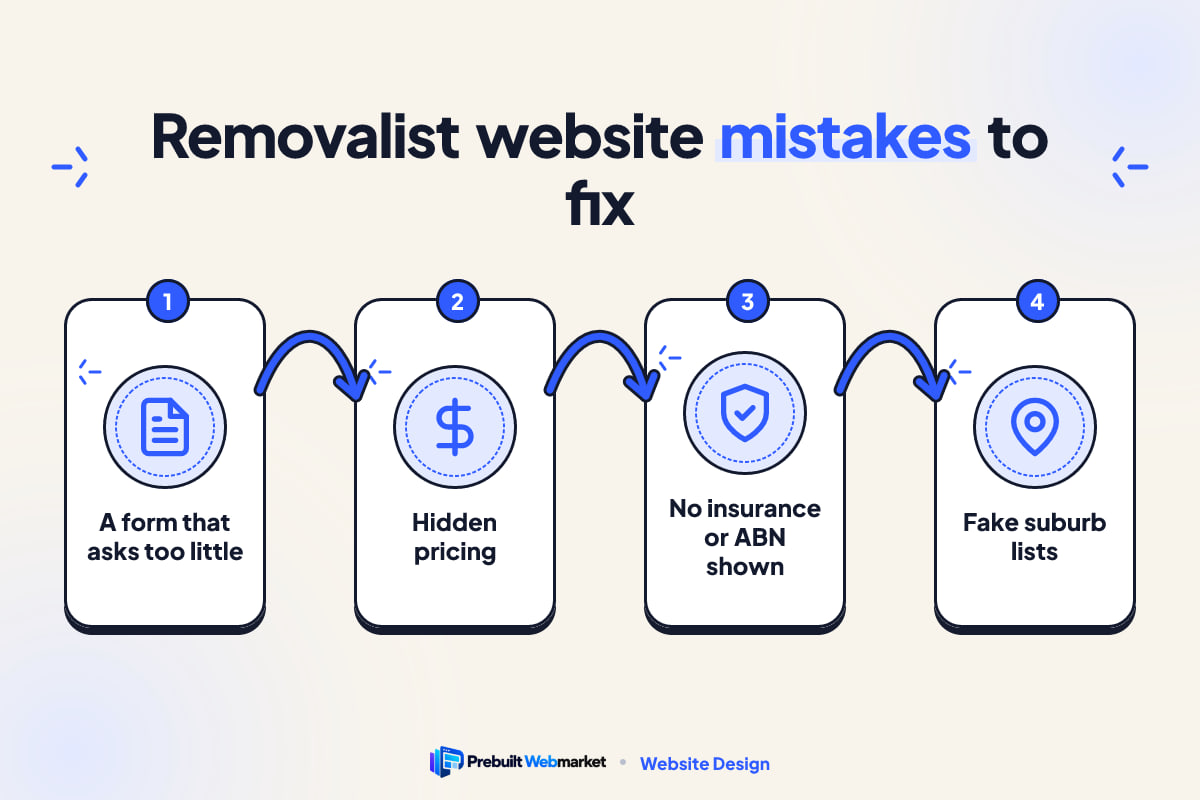
The removalists website mistakes that cost the most are a quote form that cannot produce a quote, unexplained pricing, a slow mobile site, missing proof of insurance and real crews, no suburb or route pages, and slow follow-up. Most are cheap to fix. Fix the quote form and follow-up first, because that is where enquiries you already have are being lost.
Key takeaways
- Rank fixes by impact: the quote form and follow-up lose enquiries you already won, so fix them before chasing more traffic.
- Ask about stairs, lifts, parking, large items and dates on the form, or every quote turns into a phone call.
- Explain how you charge (hourly, fixed price or per cubic metre for backloading) and what changes the price.
- Show insurance, an ABN, real crew photos and a clear damage claims process near the top of the page.
- Build real pages for the suburbs and interstate routes you actually run, not one long list of place names.
- Use Australian spelling, terms and phone formats; a site that says "movers" and "zip code" looks borrowed.
In this article
- How removalists website mistakes turn into lost moves
- Which removalists website mistakes cost the most?
- Mistake 1: A quote form that cannot produce a quote
- Mistake 2: Pricing nobody can understand
- Mistake 3: A slow, heavy removalists website on mobile data
- Mistake 4: No proof you can be trusted with someone’s home
- Mistake 5: One page for every kind of move
- Mistake 6: No suburb or route pages
- Mistake 7: Thin content that Google and AI assistants cannot use
- Mistake 8: Slow or no follow-up on enquiries
- Mistake 9: A site that sounds American or generic
- Mistake 10: Never checking whether the site works
- What does it cost to fix these mistakes?
- A self-audit checklist for your removalists website
- How PrebuiltWebMarket helps removalists avoid these mistakes
- Your next step
- Frequently asked questions
The removalists website mistakes that cost you the most customers are not about colours or logos. They are a quote form that cannot produce a quote, pricing nobody can understand, a site that crawls on mobile data, no proof you are insured and accountable, no pages for the suburbs and routes you run, and enquiries that wait hours for a reply. Each one quietly sends a booked move to another removalist.
This guide is for owners of Australian removalist businesses, from a two-truck local operator to a company running interstate and office relocations. It ranks the mistakes by how much work they lose, explains what each one costs in plain numbers, and gives you the fix. At the end there is a self-audit checklist you can run on your own removalists website in about fifteen minutes.
How removalists website mistakes turn into lost moves
A removalist does not sell a product someone browses for fun. People land on your site with a date, an address and a problem. They want to know three things fast: can you do it, roughly what will it cost, and can they trust you with everything they own. Every mistake on this list gets in the way of one of those three answers.
Customers compare three or four removalists at once
Many people moving house request several quotes. They open a few sites, fill in a few forms and wait. The removalist who replies first with a clear, believable price is in the strongest position. A site that makes the customer work harder, or replies the next day, is often out of the running before the owner has seen the enquiry.
One lost move is worth a lot
A local house move is often several hours of work for a crew and a truck. An interstate move or an office relocation is worth far more. That means a small leak in your website adds up quickly. Losing two or three moves a month to a broken form or a slow reply can cost more each year than most businesses spend on their website in a decade.
The chart below is a worked example. It assumes 50 quote requests a month and an average job value of $1,200, then shows the monthly revenue at different booking rates. Swap in your own numbers.
- $12,00020% booked (10 moves)
- $15,00025% booked (12.5 moves)
- $18,00030% booked (15 moves)
- $21,00035% booked (17.5 moves)
Example only. Your enquiry numbers, booking rate and job values will differ.
Source: Illustrative example: 50 quote requests a month x booking rate x $1,200 average job
In this example, moving from 1 in 5 enquiries booked to 3 in 10 adds $6,000 a month with no extra traffic at all. That is why the fixes below start with the enquiries you already get, not with advertising.
Most mistakes are cheap to fix
The good news is that very few of these problems need a new brand or a big budget. Several are a change to a form, a paragraph or a phone number. The expensive mistake is leaving them in place for another busy season.
Which removalists website mistakes cost the most?
The removalists website mistakes that cost the most are the ones that lose enquiries you have already earned: a weak quote form, slow follow-up and unexplained pricing. Next come trust and speed problems that make visitors leave, and last come the SEO gaps that limit how many people find you. Fix them in that order.
The table ranks the ten mistakes covered in this guide by their usual impact and shows how much effort the fix takes.
| Rank | Mistake | What it costs you | Effort to fix | Section |
|---|---|---|---|---|
| 1 | A quote form that cannot produce a quote | Every enquiry becomes a phone call; slow quotes lose jobs | Low | Mistake 1 |
| 2 | Slow or no follow-up | Enquiries book whoever replies first | Low to medium | Mistake 8 |
| 3 | Pricing nobody can understand | Price shoppers leave; invoices get disputed | Low | Mistake 2 |
| 4 | No proof of insurance, ABN or real crews | Careful customers choose a removalist who looks accountable | Low | Mistake 4 |
| 5 | A slow mobile site with no tap-to-call | Visitors leave or ring the next result | Low to medium | Mistake 3 |
| 6 | Never testing the form and phone number | Enquiries vanish and nobody notices | Low | Mistake 10 |
| 7 | One page for every kind of move | Interstate, office and piano customers cannot find their job | Medium | Mistake 5 |
| 8 | No suburb or route pages | You rarely appear for local and interstate searches | Medium | Mistake 6 |
| 9 | Thin content that Google and AI tools cannot use | Fewer visitors and no AI recommendations | Medium, ongoing | Mistake 7 |
| 10 | A site that sounds American or generic | Looks like a cheap overseas template | Low | Mistake 9 |
The sections below are numbered in the order a customer meets each problem, from the quote form through to the follow-up, and the last column shows where each one is covered.
Mistake 1: A quote form that cannot produce a quote
The single most common problem on removalist sites is a contact form dressed up as a quote form. It asks for a name, phone number, email and moving date, then says “we will be in touch”. You cannot price a move from that, so every enquiry becomes a ten-minute phone call, often while you are on a job.
What the form needs to ask
A good removalist quote form collects what you need to give a real estimate, in a few short steps:
- From and to: suburbs or postcodes for both ends, so you can work out travel time.
- Property type and size: apartment, townhouse or house, and the number of bedrooms.
- Access at each end: stairs, a lift, a long walk from the truck, parking restrictions or a loading dock.
- Large or special items: pianos, pool tables, safes, gym equipment, large fridges.
- Services: packing, unpacking, boxes and materials, storage, cleaning.
- Date and flexibility: the preferred day and whether a nearby day would work.
Put the easy questions first and the contact details last. People who have already chosen their bedrooms and access are far more likely to finish.
Asking too much is also a mistake
The opposite mistake is a 25-field form that asks for a full inventory before anyone has spoken. Keep the form to what changes the price. Offer an optional photo upload or a video survey booking for larger moves, rather than forcing every customer to list every box.
Strata, body corporate and lift bookings
Apartment moves in Sydney, Melbourne, Brisbane and Perth often need a lift booking, a loading dock time or a certificate of currency for the building manager. A simple tick box, “my building needs a lift booking or insurance certificate”, tells you about it before moving day, and shows the customer you have done this before. Our Queensland removalists website guide goes deeper on highset homes and body corporate rules in that state.
Mistake 2: Pricing nobody can understand
Removalist pricing is genuinely complicated, which is exactly why customers want it explained. A site with no prices at all makes people assume you are expensive or that the quote will change on the day. Many leave and go to the removalist who explains it.
You do not need a fixed price for every job. You need to explain how you charge, what is included and what changes the total. The table shows the common pricing models and what each one should say on your site.
| Pricing model | Best for | What to explain on your site |
|---|---|---|
| Hourly rate | Local house and apartment moves | Crew size and truck, minimum hours, when the clock starts and stops, travel or call-out time |
| Fixed price | Customers who want certainty | What the price is based on, what is included, what would change it |
| Per cubic metre (backloading) | Interstate moves on shared trucks | How volume is measured, pick-up and delivery windows, why it costs less than a dedicated truck |
| Dedicated truck | Larger or urgent interstate moves | Direct transit, fixed dates, why it costs more than backloading |
| Itemised extras | Packing, pianos, storage, materials | A short price list or starting prices for each extra |
Two of our live demos show these models clearly. Little Wombat Movers, set in Melbourne, explains hourly removals alongside interstate backloading by the cubic metre. Harbour City Removals in Sydney leads with fixed-price house, office and interstate moves.
Say what is included
Customers compare quotes line by line. Say whether your rate includes blankets and furniture protection, a trolley, basic disassembly and reassembly of beds, and fuel. If something costs extra, say so on the page, not on the invoice.
Show the total the customer will pay
Australian customers expect to see the full price they will pay, including GST. If you list an hourly rate, make it clear whether it includes GST and any fuel or booking fees. Check the ACCC’s guidance on pricing if you are unsure how to display it.
Mistake 3: A slow, heavy removalists website on mobile data
Many people search for a removalist on a phone, often while standing in a half-packed house or on a lunch break. A site loaded with large photos, video backgrounds and page builder plugins can take long enough to load on mobile data that the visitor gives up and taps the next result.
Where the weight usually comes from
The usual causes are photos uploaded straight from a camera, sliders and video headers, chat widgets and tracking scripts loaded on every page, and themes that bundle features you never use. Each one adds to the load time. Our guide to website speed for local businesses explains each cause and how to test for it.
How to test your own site
Open your site on your phone, on mobile data rather than Wi-Fi. Time how long it takes before you can tap the quote button. Then run the page through Google’s free PageSpeed Insights tool and look at the mobile score, not the desktop one. If the mobile result is poor, start with image sizes and anything that plays automatically.
No tap-to-call or text
A phone number written as plain text, or a number only in the footer, is a small mistake with a big cost. Put a call button and a text button at the top of every page on mobile. Some customers will never fill in a form; they want to ring, describe the job and get a feel for who they are dealing with.
Mistake 4: No proof you can be trusted with someone’s home
A removalist walks out of a customer’s house with everything they own. Customers know this, and many have heard stories of rogue operators who hold goods until an inflated bill is paid. A site with stock photos, no business details and no mention of insurance gives careful customers every reason to keep looking.
The trust details that matter most
Put these near the top of the home page and on every quote page, not buried on an About page:
- Your ABN and business name, so customers can check you are a registered business.
- The insurance you hold and what it covers. Say what public liability cover you carry, whether you offer transit insurance or how customers can arrange it, and what is and is not covered.
- A plain damage claims process. Who to contact, how quickly you respond and how claims are assessed.
- Real photos of your crew and trucks, with your branding visible. Stock photos of smiling people in spotless uniforms fool nobody.
- Genuine reviews that name the suburb and the job, such as “three-bedroom house from Penrith to Castle Hill”, with a link to your Google reviews.
- Any industry association membership, if you hold one, with a link to check it.
Confirm with your insurer exactly what your policies cover before you describe them on the site, and keep the wording accurate.
Say how you handle the awkward parts
Explain what happens if the move runs over time, if access at the new place is worse than described, or if the keys are not ready at settlement. A short “what to expect on moving day” section answers worries before they become reasons to choose someone else.
Show what kind of removalist you are
Design should match the work you want. A family business doing local moves suits a friendly, approachable look. An office relocation company needs to look organised and corporate. Coastline Office Relocations, our Perth demo, is built around a Friday shutdown and a Monday start, which is exactly what an office manager is worried about.
Mistake 5: One page for every kind of move
Many removalist sites have a single “Services” page with a list: local moves, interstate, office, packing, storage, pianos. That page tries to rank for everything and ranks for very little. It also forces an office manager and a family moving interstate to read the same generic text.
Give each service its own page
Each main service needs its own page with its own quote button. For most removalists that means Local Removals, Interstate, Office Removals, Packing, Storage and a page for specialist items such as pianos and pool tables. Each page should answer the questions that customer actually asks.
What each service page should answer
- Local removals: hourly rates, crew sizes, how long a typical two or three-bedroom move takes, apartment and lift moves.
- Interstate: routes you run, transit times, backloading versus dedicated trucks, storage in between, how you protect goods over long distances.
- Office removals: after-hours and weekend moves, IT equipment, minimising downtime, a project contact.
- Packing: full or partial packing, materials, fragile items, unpacking at the other end.
- Storage: short and long-term options, how goods are stored and insured, access.
- Pianos and heavy items: the equipment you use, stairs, and the extra cost.
For a fuller list of what each page needs, our movers lead follow-up guide covers the estimate form and the details worth capturing on each one.
Mistake 6: No suburb or route pages
Most removalist searches include a place: “removalists Parramatta”, “removalists near me”, “Melbourne to Brisbane removalists”. Google decides who to show based partly on how clearly your site connects your business to that place. A footer that lists fifty suburbs does not do that.
Suburb pages that are actually useful
Build a page for each area you genuinely serve and want more work in. Make it useful to someone who lives there: the kinds of properties, common access issues such as apartment towers, steep driveways or narrow terrace streets, parking rules, typical jobs and a few local reviews. A page that could be copied to another suburb by changing the name is not worth publishing.
Route pages for interstate work
If you run interstate moves, build a page for each route you run regularly, such as Sydney to Brisbane or Perth to Adelaide. Explain typical transit times, whether you offer backloading or a dedicated truck, and how pricing works on that route. Customers moving thousands of kilometres want to know you do that trip often, not that you are willing to try.
If you serve a particular state, look at how we approach websites for New South Wales businesses, Victorian businesses and businesses in Western Australia.
Mistake 7: Thin content that Google and AI assistants cannot use
SEO, or search engine optimisation, is the work of helping your business appear when people search. For a removalist it is mostly local. A five-page site with two sentences on each page gives Google very little to work with, and gives AI tools nothing to quote.
The local SEO basics most removalists skip
- Complete your Google Business Profile. Choose the most accurate category, list your services and service areas, add real photos and keep your hours current.
- Keep your details identical everywhere. The same business name, phone number and address on your site, Google, Facebook and directories.
- Ask every customer for a review, by text, straight after the move, with a direct link.
- Give every page a clear title and description that names the service and the area.
- Connect Google Search Console so you can see which searches show your site and fix errors.
What AEO and GEO mean for a removalist
AEO, answer engine optimisation, means structuring content so it can be shown as the direct answer to a question. GEO, generative engine optimisation, means making your business easy for AI tools such as ChatGPT, Gemini, Perplexity and Google’s AI Overviews to understand and cite. Our plain-English guide to AEO and GEO explains both.
In practice that means writing the way customers ask. Use questions as headings, such as “How much does a two-bedroom move cost in Sydney?” or “What is backloading?”, and answer them in the first two sentences. State facts plainly: “We run weekly backloads from Melbourne to Brisbane, priced per cubic metre.” Add LocalBusiness and FAQ schema, which is code that labels your details so machines can read them reliably. Nobody can guarantee an AI recommendation; you can remove the reasons to skip you.
Content that follows the moving calendar
Moving has seasons. End-of-lease periods, school holidays and the end of the financial year are busy, and university moves cluster around semesters. A blog that publishes a packing checklist, a guide to backloading or an end-of-lease moving guide before each busy period gives people a reason to find you, and gives you pages that answer real questions.
Mistake 8: Slow or no follow-up on enquiries
A removalist website can do everything right and still lose the job if the enquiry sits in an inbox until the evening. Customers who send three quote requests often book the first removalist who replies with a clear answer. You are on a job, carrying a fridge down stairs, and the enquiry waits.
Missed calls are missed moves
When a caller reaches voicemail, many hang up and ring the next number. A missed-call text-back sends them a message straight away: “Sorry we missed you, we are on a move. What date and suburbs are you moving between? We will call you back within the hour.” That one text keeps many of those callers from moving on.
A simple follow-up sequence
A CRM, customer relationship management system, records every enquiry and sends the right message at the right time. The table shows a sequence that suits most removalists.
| When | What happens | Why it matters |
|---|---|---|
| Within 1 minute | Automatic text and email confirming the request and what happens next | The customer knows you are real and responsive |
| Within 30 minutes, in business hours | A person calls or texts to confirm details and give a price | A human reply with a price wins trust |
| Next day | Short follow-up if there is no reply | Many people simply got busy |
| 3 days before the move | Reminder with arrival window, what to prepare and parking notes | Fewer surprises and delays on the day |
| Day after the move | Thank you and a review request with a direct link | Reviews help the next customer choose you |
Australia’s spam rules, which the ACMA enforces, require consent before you send marketing messages and an easy way to unsubscribe. Add a clear consent line to your quote form and keep service messages, such as booking reminders, separate from promotions.
Know where every move came from
Ask on the form or the first call how the customer found you, and record it. After a few months you will know whether Google, reviews, referrals or ads bring the moves that pay best, and where to spend your time.
Mistake 9: A site that sounds American or generic
Many cheap templates and overseas agencies produce removalist sites that say “movers”, “moving company”, “zip code” and “color”, with phone numbers in the wrong format. Australian customers notice. It makes the business look like it was set up in an afternoon by someone who has never been here.
Use Australian words and formats
Write “removalist”, “suburb”, “postcode”, “enquiry”, “colour” and “organise”. Show mobile numbers as 04xx xxx xxx and landlines with the area code in brackets. Put prices in Australian dollars with GST made clear. Use the names of real suburbs, roads and landmarks your customers know.
Write like a person, not a brochure
Generic lines such as “your trusted moving partner” or “we go above and beyond” say nothing. Specific lines work better: “Two-person crew and a 6-tonne truck, minimum 3 hours, with blankets, a trolley and bed reassembly included.” Replace every sentence that could appear on any removalist’s site with one that could only appear on yours.
Mistake 10: Never checking whether the site works
The last mistake is the simplest. Forms break, email addresses change and phone numbers get updated everywhere except the website. Many owners never test their own quote form after launch.
A monthly five-minute test
Once a month, on your phone, fill in your own quote form and check that the email and text arrive. Tap the call button. Open your main service pages. Check your opening hours and prices are current. Ask a friend to find a price on your site and time them. This takes five minutes and catches problems before they cost a busy month.
What does it cost to fix these mistakes?
Fixing a few removalists website mistakes, such as a form, a phone button or some wording, can cost very little if your platform makes edits easy. A rebuild costs more: a freelancer or agency usually charges thousands of dollars and takes weeks, while a prebuilt removalists website from PrebuiltWebMarket starts at US$97 a month plus US$297 setup.
The table compares the realistic options honestly. Each suits a different business. For a fuller version, see our comparison of website options and the guide to website builders versus prebuilt sites.
| Option | Time to fix or rebuild | Upfront cost | Who maintains it | Best for |
|---|---|---|---|---|
| Fix it yourself | Hours to weeks of your time | Low | You | Owners with time and a site that is mostly sound |
| Do-it-yourself builder | Weeks of your time | Low | You | New operators with more time than budget |
| Freelancer | Usually several weeks | Medium to high | You, or the freelancer by the hour | Owners with a clear brief and time to manage it |
| Agency | Often 1 to 3 months | High | The agency, on a retainer | Larger companies wanting a fully custom brand |
| Prebuilt website | About 7 days | US$297 setup | We do, with monthly edits included | Owners who want it done properly and quickly |
If your site is basically sound, fix the form, phone button and pricing yourself this week. If it is slow, hard to edit and missing most of the pages above, a rebuild is usually cheaper than patching. Our guide to how long a business website takes to build explains what causes delays on each route.
What our plans cost in the first year
The chart shows the first-year cost of each PrebuiltWebMarket plan on monthly billing, including the one-time setup fee.
- Launch (US$97 x 12 + US$297 setup)$1,461
- Growth (US$297 x 12 + US$297 setup)$3,861
- Scale (US$497 x 12 + US$297 setup)$6,261
Prices in US dollars. Paying yearly costs less: $970, $2,970 and $4,970 a year, plus the same setup fee.
Source: PrebuiltWebMarket pricing, 2026
Launch is the website. Growth adds the blog with two articles a week and search console setup. Scale adds the GoHighLevel CRM with automated follow-up. Compare all three on the pricing page. In the worked example earlier, a single extra booked move at $1,200 a month covers the Launch plan many times over; your own numbers will differ.
A self-audit checklist for your removalists website
Run this checklist on your phone, on mobile data, and mark each line pass or fail. It takes about fifteen minutes. Anything that fails links back to the mistake above that explains the fix.
| Check | Pass if | Mistake |
|---|---|---|
| Quote form | It asks about property size, access, large items and dates, and you could price from it | 1 |
| Pricing | A visitor can find how you charge and what changes the price in under 30 seconds | 2 |
| Speed | The quote button is usable within a few seconds on mobile data | 3 |
| Call and text | Call and text buttons are visible at the top of every page on a phone | 3 |
| Trust | ABN, insurance, claims process and real crew photos are visible without hunting | 4 |
| Service pages | Local, interstate, office, packing and storage each have their own page | 5 |
| Suburbs and routes | Your main areas and interstate routes have useful pages of their own | 6 |
| Google Business Profile | Complete, accurate and matching the site | 7 |
| Questions answered | Common questions appear as headings with direct answers | 7 |
| Follow-up | An enquiry gets an automatic reply in minutes and a human reply the same day | 8 |
| Language | Australian spelling, terms and phone formats throughout | 9 |
| Working form | You tested it this month and the enquiry arrived | 10 |
How to prioritise what fails
Fix the quote form, call buttons and follow-up first, because they lose enquiries you already have. Then fix pricing and trust, which decide whether visitors enquire at all. Leave suburb pages and content until last; they grow your traffic over months, so they are worth doing, but they will not help if the site cannot turn visitors into booked moves.
Fixes you can make this week
- Add access, large items and date flexibility questions to your form.
- Add a call and text button to the top of every mobile page.
- Write one paragraph explaining how you charge and what is included.
- Put your ABN, insurance and a crew photo on the home page.
- Set up an automatic reply to every form enquiry.
How PrebuiltWebMarket helps removalists avoid these mistakes
A prebuilt removalists website is a finished design, already tested for speed and enquiries, that we customise for your business. Good removalists website design is mostly about avoiding the mistakes above, so each of our designs is built around them, and you can see the result before you pay. There are three live removalists website demos: Harbour City Removals in Sydney for fixed-price house, office and interstate moves, Little Wombat Movers in Melbourne for hourly removals and backloading, and Coastline Office Relocations in Perth for commercial relocations. Each one has an interstate quote form, suburb service-area pages, specialist item pages and Australian copy built in.
When you choose one, this is what happens:
- You pick a design and book a call.
- We customise it with your logo, colours, services, pricing, suburbs and routes.
- We launch it within 7 business days of receiving your content, on your own domain.
- We look after it, with hosting, SSL, daily backups and your monthly edits included.
Every site is guaranteed to score 100 out of 100 for on-page SEO and 95 or more for PageSpeed performance at launch. If you are not happy within 30 days, we refund your first month. Plans are month-to-month, and you keep your domain, your content and your leads. We do not promise rankings or a set number of moves; we build a site that removes the mistakes above. You can also browse all 29 industries we build for or see the locations we serve.
Your next step
Run the self-audit checklist on your own site today. If the quote form, pricing and follow-up pass, keep improving your suburb pages and content. If two or more of the top five checks fail, your website is probably costing you booked moves every week.
Open the removalist demos above and pick the one closest to the business you want to look like, then book a free 45-minute call and we will go through your current site honestly. If you would rather write to us first, use the contact form.
Frequently asked questions
What is the most common mistake on removalists websites?
A quote form that cannot produce a quote. Many removalist forms ask only for a name, phone number and moving date, so every enquiry needs a long phone call before a price can be given. Add questions about property size, stairs, lifts, parking, large items and flexibility on dates, and you can reply with a real estimate faster than competitors.
Should a removalist show prices on their website?
Yes, at least explain how you charge. Show your hourly rate for a two-person crew and truck, or starting prices for fixed-price moves, and list what changes the price: stairs, distance, packing, pianos and travel time. Customers who understand the price send better enquiries and are less likely to dispute the invoice afterwards.
How fast should a removalist reply to a website enquiry?
Within minutes during business hours, and with an automatic acknowledgement at any hour. People moving house often send several quote requests at once, and the first removalist to reply with a clear answer has an advantage. An automatic text or email that confirms the request and says when a person will call keeps you in the running.
Do removalists need separate pages for each suburb?
Only for the suburbs and areas you genuinely serve and want more work in. A useful suburb page covers the kinds of properties there, access issues such as apartment lifts or narrow streets, typical jobs and local reviews. One page listing fifty suburbs in a paragraph rarely ranks and does not persuade anyone.
What should a removalist put on their website to build trust?
Show your ABN, the insurance you hold and what it covers, real photos of your crew and trucks, genuine reviews that name the suburb and type of move, and a plain explanation of how damage claims work. Customers are handing over everything they own, so they look for proof that you are a real, accountable business.
Is it worth having interstate removal pages on my website?
Yes, if you run interstate moves. Interstate customers search by route, such as Sydney to Brisbane or Melbourne to Perth. A page for each route you run regularly, explaining typical transit times, whether you offer dedicated trucks or backloading, and how pricing works, gives those customers a clear reason to contact you.
How much does it cost to fix a removalists website?
It depends on how much is wrong and who fixes it. Small changes to forms and wording can be done in a day on most platforms. A rebuild with a freelancer or agency usually costs more and takes weeks. A prebuilt removalists website from PrebuiltWebMarket costs from US$97 a month plus US$297 setup and launches in about 7 days.
Can my removalists website get recommended by ChatGPT or Google AI Overviews?
It can be included, but nobody can guarantee it. AI assistants favour websites that state what the business does, where and how it charges in plain sentences, answer real questions directly, use schema markup and match the details on Google Business Profile and directories. Removing those gaps gives you the best chance of being cited.
Does it matter if my removalist website uses American spelling?
Yes. Australian customers notice words like movers, zip code, color and moving company, and US-style phone numbers. It makes the site look like a cheap overseas template and weakens trust. Use Australian spelling, terms such as removalist, suburb and enquiry, and phone numbers in Australian formats.