
Quick answer
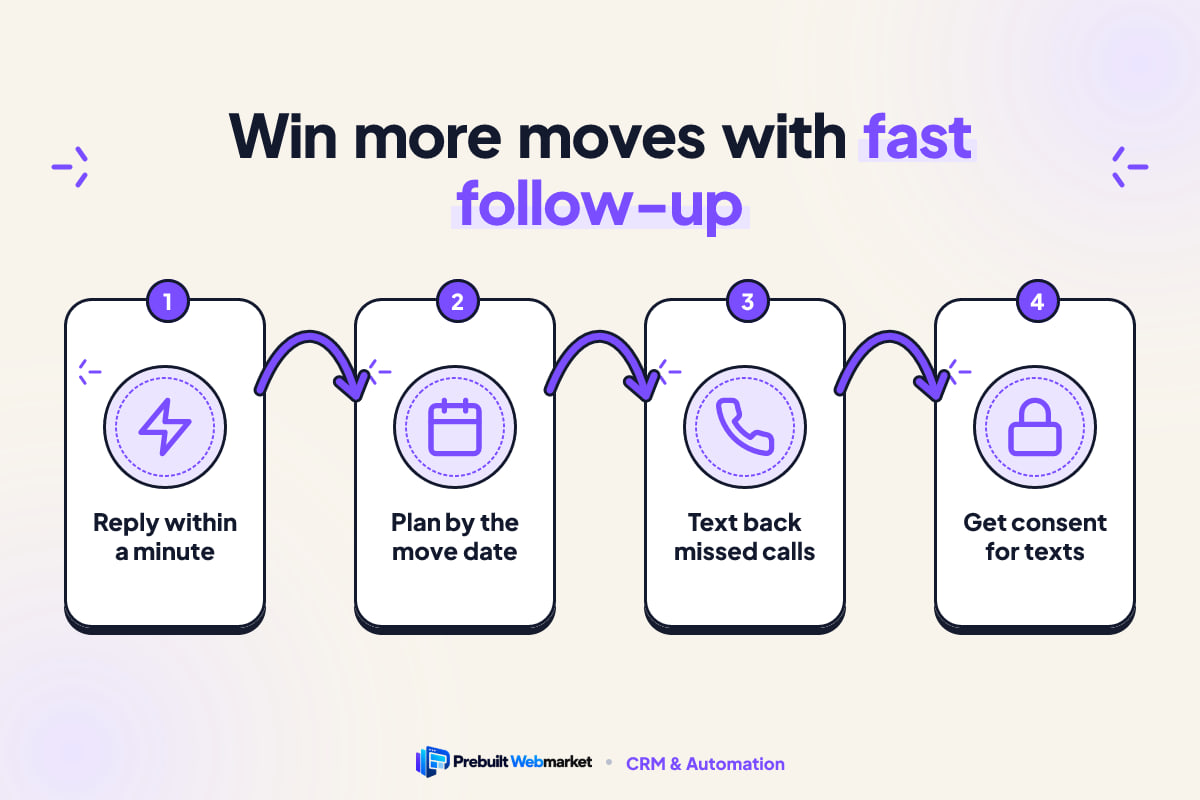
Movers win jobs by replying first with a clear next step. Connect your movers website to a CRM such as GoHighLevel so every quote request gets an instant text and email, missed calls get a text back, each lead moves through a pipeline, and booked customers get reminders and a review request. Only text people who have agreed to it.
Key takeaways
- Moving quotes are shopped side by side, often on the same evening, so the first clear reply has a real advantage.
- A CRM records every website lead, replies automatically within a minute and reminds your team to call.
- Plan follow-up around the move date, not the enquiry date: a move 8 weeks out needs a different sequence from one this Saturday.
- Missed-call text-back stops callers ringing the next mover while your crew is on a job.
- Collect clear consent on the quote form before you send marketing texts, and honour STOP replies straight away.
- Track reply time, booking rate and the source of every booked move so you know what is working.
In this article
- Why do movers lose leads they already paid for?
- What your movers website should capture before follow-up starts
- How a CRM handles movers website leads
- A sample follow-up sequence for a moving company
- Pipeline stages from quote request to five-star review
- Missed-call text-back and after-hours replies
- What are the rules for texting moving leads?
- Measuring speed to lead and booked moves
- Getting more quote requests: SEO and AI search for your movers website
- Your follow-up options compared honestly
- Seven follow-up mistakes moving companies make
- A 30-day plan to fix lead follow-up
- How PrebuiltWebMarket helps moving companies follow up faster
- Your next step
- Frequently asked questions
Moving companies do not usually lose jobs because their price is wrong. They lose them because someone else replied first. Getting your movers website leads into a CRM fixes that: every quote request gets a text and email within a minute, a person calls soon after, missed calls get a text back, and nobody waits until Monday because the form landed in a crowded inbox on Friday night.
This guide is for owners of local, long-distance and commercial moving companies in the United States. It explains why speed of reply decides so many moves, what your website needs to capture, how a CRM such as GoHighLevel automates follow-up, and a sample sequence you can copy. It also covers pipelines, pre-move reminders, review requests, the consent rules for business texting and what each option costs.
Why do movers lose leads they already paid for?
Movers lose paid-for leads mainly through slow or patchy follow-up. A customer fills in three or four quote forms in one sitting, then talks to whoever responds first with something useful. If your reply arrives the next morning, they may already have a video survey booked with another company. The lead was real; the response was too late.
Moving has a few features that make this worse than in most trades.
Customers shop several movers at once
Hiring a mover is a large, nervous purchase, so people compare. They search, open several tabs, and fill in a form on each moving company website that looks credible. The quotes then sit side by side. The company that replies first, explains what happens next and gives a clear time for a survey or estimate sets the standard the others are judged against.
Lead-sharing sites sell the same customer more than once
If you buy leads from a moving lead site, the same customer is often sent to several movers at the same time. In that situation the reply in the first few minutes is almost the whole game. A lead you reply to after two hours is a lead you paid for and handed to a competitor.
The move date is fixed and the clock is running
Most service enquiries can wait a week. A move cannot. Someone closing on a house on the 30th, or leaving a lease at the end of the month, needs certainty fast. Every day without a confirmed quote makes them more anxious and more likely to book whoever sounds organised.
Your team is busy when the leads arrive
Quote requests come in the evening and at weekends, when people sort out their lives. That is also when your crews are loading trucks and your office may be closed. Without automation, a Saturday enquiry often gets its first reply on Monday.
Customers worry about rogue movers
Many customers have heard stories about hostage loads and quotes that double on moving day. A fast, professional reply that names a real person, explains how your estimate works and shows your USDOT number where it applies reassures them that you are a real company. Silence feeds the worry.
What your movers website should capture before follow-up starts
Follow-up can only be as good as the information your website collects. A form that asks for a name and email gives your team nothing to work with. A well-built quote form gives the CRM enough to send a useful reply and gives your estimator enough to call with a real answer.
Good movers website design treats the quote form as the most important part of the site, not an afterthought on the contact page.
A multi-step estimate form
A multi-step form asks a few questions per screen: move type first, then date and locations, then home size, then contact details. On a phone it feels quicker than one long form, and each answer can tag the lead in your CRM. The table below shows what to ask and how each answer helps follow-up.
| Question on the form | Why it matters for follow-up |
|---|---|
| Move type: local, long-distance, commercial | Sends the lead to the right pipeline and person |
| Move date, or “flexible” | Decides how urgent the follow-up is and when reminders go out |
| Moving from and to (ZIP codes) | Shows distance and whether you serve the route |
| Home size or number of rooms | Gives a rough price range for the first reply |
| Extras: packing, storage, piano, stairs | Lets the estimator prepare before calling |
| Phone, email and best time to call | Lets the CRM text, email and schedule a call task |
| Consent to receive texts (unticked box) | Records permission for follow-up texts |
Tap-to-call and tap-to-text
Many people would rather call. Put the phone number at the top of every page as a button that dials when tapped, and route calls through a number your CRM tracks. Then every call, answered or missed, is logged against the lead.
A way to book a video survey
For anything beyond a small local move, an accurate estimate usually needs a walkthrough. Let customers pick a time for an in-home or video survey straight from the form’s thank-you page. A booked appointment is far stronger than “we will be in touch”.
Source tracking on every lead
Record where each lead came from: Google search, your Google Business Profile, a paid ad, a lead site, a realtor referral. Without this you cannot tell which marketing actually books moves. A CRM can capture this automatically from your website.
You can see these pieces working on our movers demos. BlueLine Moving Co. in Charlotte leads with free written quotes for local, long-distance and commercial moves. Little Box Movers in San Diego uses a cube-sheet builder and shows its fees upfront, which gives the follow-up an accurate starting point. Our guide to movers website design in Washington covers the estimate form and trust signals in more depth.
How a CRM handles movers website leads
A CRM, customer relationship management system, is the software that sits behind your website and phone. It stores every lead, every message and every quote in one record per customer. GoHighLevel is one widely used CRM for local service businesses; others exist, and the principles below apply to any of them.
Here is what it does for a moving company.
One inbox for every channel
Website forms, texts, emails, calls and Facebook or Google Business Profile messages all land in one conversation view. Your office manager does not need to check five places, and anyone on the team can see what was last said to a customer before they call.
Pipelines that show where every move stands
A pipeline is a board with columns, one for each stage of a sale: new request, contacted, survey booked, quote sent, booked, completed. Each lead is a card that moves across. At a glance you see how many quotes are waiting for an answer and which ones have gone quiet.
Automations that send the right message at the right time
An automation is a rule: when this happens, do that. When a website form arrives, send a text and an email. When a lead has had a quote for two days with no reply, send a follow-up. When a move is marked complete, send a review request two days later. You set them up once and they run every time.
Tasks and alerts for your team
Automation should support people, not replace them. The CRM can alert your estimator by text the moment a long-distance request arrives, create a call task with a deadline, and flag leads nobody has touched. That way the human call still happens, just faster.
A sample follow-up sequence for a moving company
The sequence below is a starting point for a residential move booked a few weeks out. It mixes automatic messages with human calls, and it stops the moment the customer books, declines or asks you to stop.
| When | Channel | What happens |
|---|---|---|
| Within 1 minute | Text and email (automatic) | Thanks them by name, confirms move date and route, names who will call, links to book a video survey |
| Within 15 minutes (business hours) | Phone call (person) | Estimator confirms details, answers questions, books the survey |
| If the call is missed | Text (automatic) | “Sorry I missed you, reply with a good time or book here” |
| Next morning | Text (automatic) | Short check-in with the survey booking link |
| After the survey | Email (person or template) | Written estimate with what is included, the estimate type and how to book |
| 2 days after the quote | Text (automatic) | Asks if they have questions and offers a quick call |
| 5 to 7 days after the quote | Email (automatic) | Final follow-up, notes how dates are filling up only if that is true |
| Booked | Text and email (automatic) | Confirmation, what happens next, packing checklist |
Write each message in plain words, sign it with a real name and keep texts short. A text that reads like a person wrote it gets more replies than one full of capital letters and links.
Local moves need speed, long-distance moves need patience
A local move for this weekend should get a call within minutes and a price the same day. A long-distance move months away has a longer decision cycle: the customer may be comparing binding and non-binding estimates and waiting on a closing date. Build two sequences. The long-distance one can include an extra check-in a few weeks later and a reminder when their date is approaching.
Commercial and office moves follow a different path
Office moves involve facilities managers, IT teams and building rules about elevators and weekend access. The sale is slower and often needs a site visit and a written proposal. Give commercial leads their own pipeline with stages such as site visit, proposal sent and decision date. Our Summit Commercial Relocation demo in Houston shows a website built for that buyer, with relocations planned to weekend move windows.
Pipeline stages from quote request to five-star review
The pipeline does not stop when the customer books. The weeks between booking and moving day are where cancellations, confusion and bad reviews start, and the days after the move are when reviews and referrals are won. The table shows a full residential pipeline and the automation attached to each stage.
| Stage | What triggers it | Automation attached |
|---|---|---|
| New request | Website form, call or message | Instant reply, alert to estimator, call task |
| Contacted | First conversation logged | Survey booking link if not yet booked |
| Survey booked | Calendar booking | Confirmation and reminder the day before |
| Quote sent | Estimate sent | Follow-ups at day 2 and day 5 to 7 |
| Booked | Deposit or signed estimate | Confirmation, checklist, reminders before move day |
| Moved | Crew marks job complete | Thank-you message, review request 2 days later |
| Lost | Customer declined or went silent | Short “can we ask why?” message, then stop |
Reminders before moving day
Booked customers need reminders as much as new leads need replies. A week before, send a packing checklist and ask them to confirm parking, elevator bookings and access at both addresses. Two days before, confirm the arrival window. The evening before, send the crew lead’s name. Each message reduces surprises on the day and the calls your office has to field.
Review requests after the move
Ask for a review a day or two after the move, once the customer has unpacked and any small issue has been sorted. Send one text with a direct link to your Google review page, and one reminder a few days later if they have not left one. Ask every customer, not only the ones you expect to be happy, and never offer anything in return for a review.
Handling claims without losing the review
If a customer reports damage, the CRM should pause the review request and create a task for whoever handles claims. Respond quickly and in writing. A customer whose claim was handled fairly often writes a better review than one who had no problem at all.
Missed-call text-back and after-hours replies
Missed-call text-back sends an automatic text to anyone who calls and does not reach a person. For a mover, whose phone often rings while the owner is on a truck, it is one of the most useful automations you can switch on.
Without it, a missed caller usually rings the next mover on their list. With it, they get a text within seconds and a simple way to keep talking to you.
What the text should say
Keep it short and useful. For example: “Hi, this is [your name] at [your company]. Sorry we missed your call. Are you planning a local or long-distance move? Reply here or pick a time for a quick call.” Then the CRM logs the reply as a new lead and alerts your team.
After-hours form replies
The same idea applies to form submissions at 9pm. The automatic reply should set expectations honestly: “Thanks, we have your request for a move on 14 November. Our estimator will call you tomorrow between 8 and 10am. If you would like to choose a time, book here.” A clear promise, kept, builds more trust than a vague “we will be in touch soon”.
What are the rules for texting moving leads?
You can reply by text to someone who asked you to contact them, but marketing texts in the US need clear prior consent, every message should identify your business, and you must stop when someone replies STOP. Federal rules enforced by the FCC apply, some states add their own, and carriers have registration requirements for business texting. Confirm the details with a lawyer or your texting provider.
This is general information, not legal advice. Rules change and the penalties for getting them wrong can be significant, so treat this section as a checklist of questions to ask.
Get consent on your website quote form
Add a checkbox, unticked by default, next to the phone field. Say in plain words what you will text (quote updates, booking reminders and occasional offers), that message frequency varies, that message and data rates may apply, and that they can reply STOP to opt out. Link to your privacy policy. Do not make ticking the box a condition of getting a quote. The CRM should store the consent, the time and the form it came from.
Register your business texting number
Mobile carriers in the US require businesses that send texts from a regular local number to register their brand and the type of messages they send, often called 10DLC registration. Your CRM or texting provider usually handles the application, but it can take days or weeks, so start before you launch your automations. Unregistered messages may be blocked or filtered.
Respect opt-outs and sensible hours
When someone replies STOP, they must stop receiving messages from you, and your CRM should do this automatically. Avoid sending automated texts late at night or early in the morning in the customer’s time zone, which matters for long-distance leads in other states. Keep a record of opt-outs even if you change software.
Keep marketing and service messages separate
A confirmation that their crew arrives at 8am is a service message. A discount on storage is marketing. Keep the two clearly labelled in your automations so that someone who opted out of offers still gets the reminders they need for their booked move, where the rules allow it.
Our GoHighLevel CRM package includes setting up these automations alongside your website, so the consent checkbox, the pipeline and the follow-up are built to work together from day one.
Measuring speed to lead and booked moves
Speed to lead is the time between a customer submitting a request and getting a useful reply. It is the first number to measure, because everything else depends on it. A CRM records it automatically for every lead.
The second number is your booking rate: the share of quote requests that turn into booked moves. Small changes add up. The chart below is a worked example for a mover receiving 60 quote requests a month from its website, showing booked moves at four booking rates.
- 9 moves15% booked
- 12 moves20% booked
- 15 moves25% booked
- 18 moves30% booked
Example only. Your request volume and booking rate will differ.
Source: Illustrative arithmetic: 60 requests multiplied by each booking rate
In this example, moving from 15% to 25% turns 9 booked moves into 15 from the same 60 requests, with no extra marketing spend. Faster replies, booked surveys and steady follow-up are what move that rate.
The numbers worth tracking each month
Keep the list short so you actually look at it:
- Median reply time for website leads, in and out of business hours.
- Booking rate by move type: local, long-distance, commercial.
- Booked moves by source: organic search, Google Business Profile, ads, lead sites, referrals.
- Survey-to-booking rate, which shows how well your estimates convert.
- Reviews received compared with moves completed.
Find out why leads were lost
When a lead goes cold, mark a reason in the CRM: price, chose another mover, date changed, did not reply. After a few months the pattern tells you whether the problem is your pricing, your speed or the quality of the leads you buy.
Getting more quote requests: SEO and AI search for your movers website
Follow-up converts the leads you have. SEO, search engine optimisation, brings more of them in, and the leads from your own website are usually better than shared leads because the customer chose you specifically.
For movers, search is local and route-based: “movers near me”, “long-distance movers Charlotte to Atlanta”, “office movers Houston”. A useful website for moving company searches has a page for each service, each main city you work from and your most common routes.
Answer the questions customers ask before they book
Customers ask the same things every week: how much does a two-bedroom local move cost, what is a binding estimate, do you move pianos, how far ahead should I book. Answer each one on your website in plain words, with the question as a heading and the answer in the first two sentences. That format is what Google’s featured snippets and AI assistants such as ChatGPT, Gemini and Perplexity lift into their answers. Our explainer on AEO and GEO for local businesses covers how that works.
Keep the technical basics right
Your movers website needs to load quickly on mobile data, use HTTPS, and have schema markup that labels your business details, services and FAQs for search engines. Our guide to website speed for local businesses explains what usually slows sites down. Every PrebuiltWebMarket site is tested to score 100 out of 100 for on-page SEO and 95 or more for PageSpeed performance at launch, though no one can guarantee rankings.
Publish route and seasonal content
The busiest moving months tend to be summer and the end of each month, so publish ahead of them: packing checklists in spring, long-distance planning guides for popular routes, and storage guides for customers between homes. If you do not have time to write, our SEO blog package publishes two articles a week on your own site.
Your follow-up options compared honestly
There are four common ways moving companies handle website leads. Each suits a different size of business, and none is right for everyone. The table compares them fairly.
| Option | Setup effort | Typical cost | Best for |
|---|---|---|---|
| Email inbox and phone | None | Lowest | Owner-operators doing a few moves a week |
| Spreadsheet plus manual texts | Low | Low | Small teams who are disciplined about checking it |
| Moving operations software | High | Medium to high | Larger movers needing dispatch, crews and inventory |
| GoHighLevel CRM set up with your website | Done for you on our Scale plan | $497 a month plus $297 setup | Growing movers who want fast automated follow-up |
When a simpler setup is enough
If you do a handful of local moves a week and answer your own phone, an organised inbox and a missed-call text-back app may be all you need. Do not buy software you will not use. The point is speed and consistency, not a particular tool.
When dedicated moving software makes sense
Larger movers with several trucks often need software for crew scheduling, dispatch, inventory and claims. Those systems are built for operations. Some include sales follow-up; some movers still use a CRM such as GoHighLevel for the front end because it handles texting, pipelines and reviews well. Ask any vendor whether it connects to your website forms.
What our plans cost in the first year
Every PrebuiltWebMarket plan includes a prebuilt movers website customised to your brand, hosting and monthly edits, with no contract. The chart shows the first-year cost of each plan on monthly billing.
- Launch ($97 x 12 + $297 setup)$1,461
- Growth ($297 x 12 + $297 setup)$3,861
- Scale ($497 x 12 + $297 setup)$6,261
Yearly billing is $970, $2,970 or $4,970 a year, plus the same $297 setup.
Source: PrebuiltWebMarket pricing, 2026
The Scale plan costs $6,261 in the first year. To judge it, use your own numbers: if your average booked move brings in a few thousand dollars, a handful of extra booked moves a year from faster follow-up covers it. If you only do a few moves a month, the Launch plan with good forms and a simple text-back may be the better fit. All three are on the pricing page, and our comparison of website options sets prebuilt against DIY builders, WordPress, freelancers and agencies.
Seven follow-up mistakes moving companies make
- Letting forms go to one person’s email. When that person is on a job or on holiday, leads sit unanswered.
- An automatic reply that says nothing. “Thanks for your message” with no name, no next step and no time is barely better than silence.
- Texting without consent. It risks complaints, blocked numbers and legal trouble. Use the checkbox and keep records.
- Following up forever. Five or six touches over a week or two is enough. After that, stop and mark the lead lost.
- No reminders after booking. Customers who hear nothing between booking and moving day get nervous and sometimes cancel.
- Asking for reviews on the day of the move. People are tired and surrounded by boxes. Wait a day or two.
- Not tracking the source of booked moves. You keep paying for leads that never book because you cannot see which ones do.
A five-minute test of your own follow-up
Tonight, fill in the quote form on your own website from your phone, then call your own number and let it ring out. Note how long it takes to get a reply, what the reply says and whether anyone calls the next morning. If the answer is “nothing happened”, that is where your missing moves are going. Our article on why a website gets visits but no leads is written for roofers, but the same checks apply to movers.
A 30-day plan to fix lead follow-up
You can fix most follow-up problems in a month. This plan puts the steps that protect existing leads first.
| Week | Focus | What to do |
|---|---|---|
| Week 1 | Stop the leaks | Route every form and call into one CRM, switch on missed-call text-back, write the instant reply |
| Week 2 | Consent and texting | Add the consent checkbox, start your texting registration, set opt-out handling and quiet hours |
| Week 3 | Pipelines and sequences | Build local, long-distance and commercial pipelines with the follow-up sequence above |
| Week 4 | After booking | Add pre-move reminders, review requests and lost-reason tracking, then review your numbers |
Start week 2 early if you can, because texting registration can take time. If your current website form cannot send leads to a CRM, fix that first; it is the foundation for everything else.
How PrebuiltWebMarket helps moving companies follow up faster
We build movers websites from designs that already exist and already work, and on the Scale plan we connect them to a GoHighLevel CRM set up for you. A prebuilt movers website means you can click through the finished site before you pay for it.
There are four live movers website demos: BlueLine Moving Co. in Charlotte, NC, Nomad Long Distance Movers in Louisville with binding estimates and GPS tracking for all 48 states, Little Box Movers in San Diego, CA, and Summit Commercial Relocation in Houston, TX. Each has a multi-step move estimate form, local and long-distance pages, packing and storage pages and a DOT or licence trust bar.
Here is what happens when you choose one:
- You pick a design and book a free call.
- We customise it with your logo, services, routes, cities and USDOT details.
- We launch it within 7 business days of receiving your content, on your own domain.
- On the Scale plan, we set up GoHighLevel: every website lead synced, automated SMS and email follow-up, pipelines and lead stages, missed-call text-back, review request automations, team users and tasks, and unlimited content edits.
Every site is guaranteed to score 100 out of 100 for on-page SEO and 95 or more for PageSpeed performance at launch. If you are not happy within 30 days, we refund your first month. Plans are month-to-month, and you own your domain, content and leads. If you are weighing up a DIY tool first, our honest guide to website builders versus prebuilt websites sets out when each makes sense. We also work with Australian removalists; see our guide to removalist websites in Queensland.
Your next step
Do the five-minute test tonight. If your quote form gets no reply until the next working day, or a missed call gets nothing at all, that is the first thing to fix, whichever tool you use.
When you are ready, open the moving company website demos and choose the one closest to how you want customers to see you. Then book a free 45-minute call and we will tell you honestly whether the Launch plan or the Scale plan with the CRM fits your business. If you would rather write, use our contact form.
Frequently asked questions
What is a CRM for a moving company?
A CRM, or customer relationship management system, is software that keeps every enquiry, call, text, email and quote in one place. For a moving company it records each quote request from your website, replies automatically, shows every lead in a pipeline from new request to booked move, and reminds your team who to call next. GoHighLevel is one popular example.
How fast should a moving company reply to a website quote request?
As fast as you can, ideally with an automatic text and email within a minute and a person calling within about 15 minutes during business hours. Customers usually request several quotes at once, and the mover who replies first with a clear next step, such as a time for a video survey, is the one they talk to first.
Can I text moving leads who filled in my website form?
You can send messages people asked for, such as a reply to their quote request, but marketing texts need clear consent. Add an unticked consent checkbox to your form that says what you will text and how often, keep a record of it, and stop immediately when someone replies STOP. Rules vary, so confirm the details with a lawyer or your texting provider.
What is missed-call text-back?
Missed-call text-back is an automation that sends a text to anyone who calls and does not reach you, usually within seconds. For a mover it might say: sorry we missed you, are you looking for a quote for a local or long-distance move? Reply here or book a call. It keeps the caller talking to you instead of dialling the next company.
Is GoHighLevel good for moving companies?
GoHighLevel suits moving companies that want website leads, texts, emails, calls, pipelines and review requests in one place. It is not a full moving operations system with crew scheduling, truck dispatch and inventory, so larger movers often use it alongside dedicated moving software. Smaller and growing movers often find it covers sales follow-up well.
How many times should I follow up on a moving quote?
A sensible pattern is an instant reply, a call within 15 minutes, a follow-up the next day, another around day 3 and a last message around day 7, then a check-in closer to the move date. Stop as soon as the customer books, says no or asks you to stop. More than that tends to annoy people.
What should a moving company website quote form ask?
Ask for the move type, move date, moving from and to, home size, and contact details first, then optional extras such as stairs, elevators, packing and storage. A multi-step form that asks a few questions per screen feels quicker on a phone. Add a consent checkbox for texts and an option to book a video survey.
How much does a CRM for movers cost?
It depends on the route. Some CRMs charge a low monthly fee per user but need you to set them up yourself. Moving software with dispatch and inventory usually costs more. PrebuiltWebMarket's Scale plan is $497 a month plus a $297 one-time setup and includes a GoHighLevel CRM set up for you alongside your website, with no contract.
Should I ask every moving customer for a review?
Yes, ask every customer, ideally by text a day or two after the move once boxes are unpacked and any small issue is sorted. Send a direct link to your Google review page. Do not offer incentives for reviews or only ask customers you expect to be happy, as that breaks review platform rules.