
Quick answer
Add an instant satellite quote to your roofing website if most of your work is full asphalt replacements on ordinary homes and you can call every quote back within the hour. Skip it, or use sample prices instead, if you mostly do repairs, insurance claims, slate, tile or commercial work. Always show a range, say what it excludes and make the inspection the next step.
Key takeaways
- An instant quote works best for roofers whose work is mostly full shingle replacements on homes with ordinary roof shapes.
- Aerial imagery can be months or years old and cannot see decking, layers or ventilation, so the number is a range, never a price.
- Sample prices for three typical homes give most of the benefit with less risk and no measurement fees.
- Repair-led, insurance-led, heritage and commercial roofers should keep the free inspection as the main offer.
- The range needs plain words beside it: what it includes, what it leaves out and what happens next.
- Whatever you choose, the lead is only as good as how fast someone calls it back.
In this article
- The decision behind a roofing website instant quote
- How a satellite roof quote actually works
- Option A: a live instant price range
- Option B: sample prices and a free inspection
- Option C: the range after a short conversation
- Option D: no price at all
- The questions that decide it
- How to word the range so it is not a promise
- Where an instant quote is the wrong answer
- What happens to the lead after the number
- Our recommendation by type of roofing business
- How to change your mind later
- Putting it on your roofing website
- Frequently asked questions
A roofing website instant quote is worth adding if most of your work is full shingle replacements on ordinary homes and someone can call every quote back within the hour. If your work is mostly repairs, insurance claims, slate, tile or commercial roofs, sample prices and a free inspection will serve you better than a live calculator.
The decision matters more for roofers than for most trades. A replacement is one of the largest repair bills a homeowner faces, the price varies widely from house to house, and the visitor knows it. A number that appears in thirty seconds can pull a nervous homeowner into a conversation they would otherwise put off. The same number, worded badly, can set an expectation your estimator spends the whole inspection trying to undo.
The decision behind a roofing website instant quote
The real decision is not whether to show prices; it is how much of the pricing conversation you let a machine start before a person takes over. Every roofing website answers the price question somehow, even if the answer is silence. The options sit on a line from “no number at all” to “a live range for this exact address”, and each point on that line attracts a different mix of visitors.
Three things change depending on where you land:
- Who fills in the form. A live price brings in people who are early in their thinking and curious about cost. A free inspection offer brings in people who already believe they need a roofer.
- What your estimator walks into. A homeowner who has seen a range arrives with a number in mind. One who has not arrives with a question.
- What you pay to run it. Live tools carry measurement fees and setup time. Sample prices cost an afternoon of writing.
Most roofers who add an instant quote do it because a competitor has one. That is a poor reason on its own. Decide based on the work you want more of, then build the page around that. If the problem you are really trying to solve is a website that gets visits but no calls, start with our list of reasons roofing websites get no leads, because a quote tool will not fix a slow page or a hidden phone number.
How a satellite roof quote actually works
A satellite roof quote measures the roof from overhead imagery, multiplies the area by your price rules and shows the result as a range. The homeowner types an address, the tool finds the building, works out the roof planes and their pitch, estimates the sloped area and applies whatever price per square and adjustments you have set.
The word “satellite” is a loose label. Google’s documentation for its Solar API, which exposes the kind of roof data many of these tools are built on, lists imagery quality levels in the Solar API service definition: HIGH quality comes from aerial imagery captured at low altitude and processed at 0.1 metres per pixel, MEDIUM from aerial imagery captured at high altitude at 0.25 metres per pixel, and LOW from enhanced satellite imagery at 0.25 metres per pixel. Commercial measurement providers use their own imagery and methods, but the principle is the same: the quality of the picture decides the quality of the number.
What the imagery can see
From above, a good image shows the outline of the roof, the ridges, hips and valleys, and the direction each plane faces. The same Google definition describes a pitch value for each roof segment, from 0 for flat to 90 for vertical, and a roof area figure that accounts for tilt, kept separate from the ground footprint.
That separation matters for your price. A tool that prices on footprint alone will undercount every pitched roof. As a worked example, a home with a 2,000 square foot footprint and an 8/12 pitch (about 34 degrees) has roughly 2,400 square feet of sloped roof, or 24 squares before your waste allowance. At 12/12 the same footprint becomes about 2,830 square feet. If the tool you are considering cannot tell you which area it uses, ask before you sign.
What the imagery cannot see
Imagery shows the surface, not the roof. It cannot tell you how many layers need tearing off, whether the decking is soft, what the ventilation is like, whether the flashing at the chimney is sound or what is under that tarp. At 0.25 metres per pixel, one pixel covers roughly 10 inches of roof, so pipe boots, small vents and step flashing are at the edge of what can be seen at all.
The picture also has a date. The Solar API definition describes the imagery date as approximate and keeps it separate from the date processing finished. A house that gained an addition, a new porch roof or a re-roof since the photo was taken will be measured as it was, not as it is. New subdivisions may not show up at all.
Option A: a live instant price range
A live instant quote shows a price range for the visitor’s own address within a minute or two, with no call and usually no contact details needed to see it. It is the most impressive option and the one with the most moving parts.
Who it suits
It suits roofers whose work is mostly full asphalt shingle replacements on houses with ordinary shapes: one or two storeys, simple gables and hips, decent access. It suits markets where homeowners shop around online before they let anyone on the roof, and businesses with an office person or estimator who can ring every new quote quickly. It also suits roofers who sell financing, because a range lets you show a monthly figure beside it.
It suits a business less well when replacements are a small share of the work, when the housing stock is old and complicated, or when nobody can follow up until the evening.
What it costs in time and money
Expect three kinds of cost. First, the provider’s fees, which are usually per report or a monthly subscription, and which vary widely between providers, so compare them on your own expected volume. Second, setup: deciding your price per square for each product line, your minimum job, steep-roof and multi-storey adjustments and your waste allowance, then testing the tool against addresses you have already roofed. Third, the ongoing work of keeping prices current when material costs move.
How the form should behave
A good instant quote asks for the address first and nothing else. Use the right autocomplete tokens described in MDN’s guide to the autocomplete attribute, such as street-address and postal-code, so a phone can fill the address in one tap. Then show the outline the tool found and ask the visitor to confirm it is their house before showing a number.
Plan for addresses the tool cannot find. The GOV.UK Design System’s addresses pattern, written for government address lookups, advises giving people a manual option when their address is missing or not properly listed. For a roofer, that means a plain “We could not measure this roof, book a free inspection instead” path, never a dead end or an error message.
When the range appears, it has to be announced to screen reader users as well as shown. The W3C’s Understanding Status Messages guidance covers exactly this case: text added to the page as the result of an action, without moving focus, should be marked so assistive technology reads it out. Ask your developer or provider to confirm the result is in a live region.
Option B: sample prices and a free inspection
Sample prices show what typical replacements cost, using three or four example homes, and send everyone who wants their own number to a free inspection. There is no live measurement and no per-report fee.
A good sample price block on a roofing website reads like a short menu: a small single-storey ranch home, a typical two-storey home, a larger or steeper home. Each one gets a price band, the product line it assumes and two or three lines on what moves the price. The visitor finds the house most like theirs and gets a feel for the cost without typing an address.
Who it suits
This suits most residential roofers, including those who do a fair amount of replacement work but also plenty of repairs. It suits businesses that cannot promise a fast call back on every enquiry, because the person who books an inspection after reading sample prices has already accepted the ballpark. It is also the safer choice where housing stock varies widely, since you are not putting a specific number against a specific house.
Our Denver roofing demo with sample prices is built around this idea, with sample roof prices, good, better and best options and financing on one page. Click through it to see how sample prices and an inspection offer can sit together without the page feeling like a sales pitch.
What it costs in time and money
The cost is a few hours of honest work: pulling your last year of replacement jobs, grouping them into three or four typical homes and writing a price band for each that you would be comfortable honouring for most homes of that type. You will need to review the bands when material prices move, which is the same discipline the live tool demands, without the subscription.
You can also mark the bands up for search engines. Schema.org defines minPrice and maxPrice for a price range as “the lowest price if the price is a range” and the highest, on a price specification. It will not make you rank on its own, but it states your range in a form machines can read without guessing.
Option C: the range after a short conversation
The third option puts a person between the visitor and the number: the homeowner gives an address and a phone number, and the range arrives by text or email after someone has looked at the roof on screen, often within the same working hour. Some roofers do the desk measurement themselves with an aerial report; others use the same provider as a live tool but keep the result behind a human check.
It suits roofers with a busy office and a varied mix of roofs, where the estimator can glance at the imagery and say “that is a simple 25-square gable, here is the range” or “that roof has three dormers and a chimney, let us come and look”. It catches the visitor who wants a number without exposing a raw machine figure for a complicated house.
The cost is speed and staff time. The visitor has to wait, and some will not. Say plainly on the page how long the wait is (“we text a price range within two working hours”) and keep that promise, because a slow answer here is worse than no tool at all.
Option D: no price at all
The last option is no price on the page and a “Call for a free quote” button. It is the most common pattern on roofing websites and the weakest for most businesses, because the price is the question every visitor arrives with, and silence sends them to the site that answers it.
There are still cases where it is right. Commercial roofers selling to property managers, heritage specialists working on slate and copper, and roofers who work almost entirely through insurance claims often have no meaningful typical price to show. Even then, explain what the price depends on and what the inspection covers, so the visitor understands why there is no number.
The questions that decide it
Five questions settle the choice for most roofing businesses. Answer them from your own job records, not from a gut feeling about what homeowners want.
What share of your work is full replacement?
If full replacements are most of your revenue, a live or human-checked range speaks to the job you want. If repairs, leak calls and maintenance are the bulk, an instant replacement quote invites the wrong conversation: the homeowner with a single missing shingle sees a full replacement price and closes the page.
How complicated are the roofs in your area?
Simple gables and hips on newer housing measure well. Older neighbourhoods with dormers, turrets, low-slope additions, multiple layers and mature trees shading the roof measure badly, and the gap between the range and the real price grows. Look at your last twenty jobs: how many would a tool have measured within reason?
Who calls the lead back, and how fast?
An instant quote creates a contact at the moment of highest interest. If nobody calls for two days, that interest goes to whoever rang first. Be honest about your office hours and your estimator’s diary before you add a tool that produces leads at nine at night.
Are you storm-led or insurance-led?
After hail or wind, the price question is often “what will my insurance cover”, not “what will a new roof cost”. A cash replacement range can confuse a homeowner who expects the claim to pay. Storm-focused roofers usually do better leading with the inspection and claim help, as our Dallas storm roofing demo does.
Can you live with the range you publish?
If the range on screen is lower than what you charge for most homes of that type, you will spend every inspection explaining it. If you cannot set a band you would honour for most ordinary homes, you are not ready to show a live number.
How to word the range so it is not a promise
The range has to read as a range, in plain words, with what it includes and leaves out right beside it. The figure is the first thing the visitor reads and the thing they remember, so the words around it carry most of the weight.
What the result panel should say
A result panel that works answers five questions in a few short lines:
- What the number is. “Estimated range for a full replacement with architectural shingles.”
- What it is based on. “Measured from aerial imagery of your roof. Imagery may not show recent changes.”
- What it includes. Tear-off of one layer, underlayment, standard flashing, clean-up and disposal, or whatever your standard job includes.
- What can change it. Extra layers, decking repairs, steep or high sections, skylights, chimneys and access.
- What happens next. “A free inspection confirms your price in writing. Most inspections take about an hour.”
Write the range as two numbers (“$X to $Y”), not a single figure with “from” in front. A single “from” price invites the reader to remember only the lowest number.
Words to leave off
Leave off “exact”, “guaranteed”, “final” and “your price”. Avoid “instant estimate” in the result itself; “estimated range” is clearer. Do not show a countdown, a “price valid for 24 hours” banner or anything else that pushes the homeowner to decide before an inspection. Advertised prices are expected not to mislead, and the rules vary by state, so check the wording with your own adviser before you publish.
Where an instant quote is the wrong answer
An instant quote is the wrong answer whenever the roof’s price depends mostly on things the imagery cannot see. That covers more jobs than tool providers tend to admit.
- Repairs and leak calls. The price depends on the cause of the leak, which no image shows.
- Insurance claims. The homeowner needs claim help and an adjuster meeting, not a cash price.
- Slate, tile, copper and heritage roofs. Material condition, salvage and detailing drive the price. Our Boston heritage roofing demo shows how a specialist can sell expertise without a calculator.
- Commercial and low-slope roofs. Membrane type, insulation, drainage and access matter more than area. A property manager expects a site visit and a written proposal.
- New builds and recent additions. The imagery may simply be out of date.
If two or more of these describe a large share of your work, the instant tool will mostly produce numbers your estimator has to retract.
What happens to the lead after the number
The lead is only as good as what happens in the next hour. A homeowner who has just seen a range is at peak interest and is probably looking at two or three other roofing sites in other tabs.
Send an automatic text and email at once that repeats the range, the inclusions and the exclusions, so the homeowner has it in writing. Then have a person call, ideally within the hour during working days, to book the inspection. If you text leads, get clear consent on the form and check the rules that apply where you work.
Track the result properly. Count addresses entered, ranges shown, contact details given, inspections booked and jobs signed. Address entries on their own tell you almost nothing. Many roofers find it easiest to run this through a CRM that records each step automatically, which is what our GoHighLevel CRM setup does for website leads, with missed-call text-back and follow-up sequences. Our complete guide to roofing websites covers the rest of the follow-up process.
Our recommendation by type of roofing business
Our recommendation depends on the work you want more of. These are starting points; your own job records should have the final say.
Residential replacement specialists
Use a live instant range, carefully set up, with an inspection booking right below the result and a fast call back. This is the one group where the tool reliably fits the job. Run your past jobs through it first, and keep sample prices on the replacement page as well, for visitors who do not want to type an address.
Mixed repair and replacement roofers
Use sample prices and a free inspection. Add a human-checked range (Option C) for visitors who ask for one, if your office can answer within a couple of hours. A live tool tends to frighten away the repair customers who make up much of your diary.
Storm and insurance roofers
Lead with the free inspection and claim help. Show sample cash prices further down the replacement page for homeowners who are not claiming, and keep any live tool off the storm damage page.
Heritage, slate, tile and metal specialists
Show past projects with honest price bands and explain what drives the cost. No live calculator. Your visitors are buying judgement, and a machine number undermines it.
Commercial roofers
Explain your scope, the roof types you handle and how a site visit works. A price calculator does not match how commercial buyers purchase, and a clear proposal process does more for you.
How to change your mind later
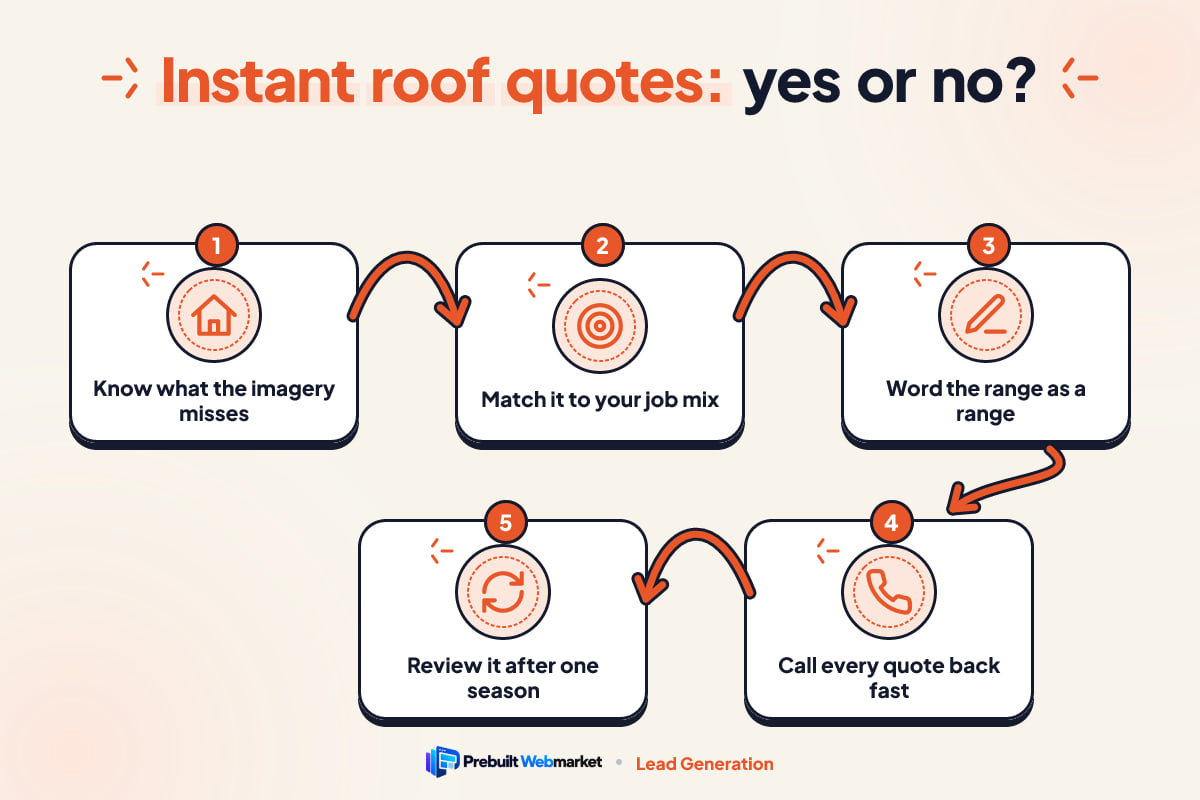
You can change your mind later without much damage, as long as you change every page at once and honour what you already quoted. The choice is not permanent; treat the first season as a test.
Adding a live tool later
Start with sample prices. After a few months you will know how many visitors read the pricing section and how many book inspections from it. If replacement enquiries are steady and your follow-up is fast, add the live tool to the replacement page first, not the home page, and compare inspection bookings over the next season.
Removing a live tool
If the tool is producing ranges that miss, leads that never answer or fees that outweigh the jobs, take it down and replace it with sample prices on the same page, so links and search results still land somewhere useful. Honour any range already sent to a homeowner within its stated terms, and update your follow-up texts and emails on the same day so nothing still mentions the tool.
What to review every season
Check the price bands against your last quarter’s signed jobs, the share of inspections where the final price fell inside the range, and the time from enquiry to first call. Those three numbers tell you whether the tool is helping or simply busy.
Putting it on your roofing website
Whichever option you choose, it should sit on a roofing website that is already fast, clear about the free inspection and easy to use on a phone. The quote tool is one component; the page around it does the persuading. Before you pay for any measurement service, make sure your replacement page explains your process, shows real projects and makes the phone number easy to tap.
If you are starting from scratch or rebuilding, a prebuilt roofing website can save you weeks. You can browse the roofing website designs we have already built, including the Denver demo with sample prices. Our website plans and pricing start at $97 a month with a $297 setup fee, and every plan launches within 7 business days of receiving your content, with 100/100 on-page SEO and 95+ PageSpeed at launch. If you are weighing a prebuilt design against a custom agency build, a freelancer or a builder you set up yourself, our comparison of website options lays out the trade-offs honestly.
Your next step: pull your last twenty replacement jobs and ask how many a satellite tool would have priced within reason. If the answer is most of them, a live range is worth testing. If not, write sample prices this week. If you would like a second opinion on which suits your business, book a free 45-minute call and we will go through your work mix and your current roofing website with you.
Sources
Frequently asked questions
How accurate are satellite roof measurements for a website quote?
Accurate enough for a starting range on a simple roof, not for a contract price. The imagery behind these tools can be months or years old, and resolution varies by area. The tool cannot see the decking, how many layers are on the roof, the ventilation or hidden damage. Treat the number as a guide that the inspection confirms, and say so beside it on the page.
Will an instant quote on my roofing website bring more leads?
It can bring more contacts, because some homeowners who would never fill in an inspection form will type an address to see a number. Whether those contacts become jobs depends on your work mix, how honestly the range is worded and how quickly you follow up. Nobody can promise more signed jobs from the tool alone, so test it for a season and count booked inspections, not form fills.
Should the instant quote ask for a phone number before showing the price?
Ask for the address first and show the range, then ask for a name and phone number to book the inspection or send the detailed estimate. Hiding the number behind a phone field feels like a trap to many visitors and invites fake numbers. A short, honest exchange of value usually produces fewer but better leads.
What should a roofer do when the instant quote is far from the final price?
Explain the difference in writing at the inspection, with photos: extra layers to tear off, rotten decking, a steeper pitch than the imagery showed or a section added since the photo was taken. Then update the wording on your website if the same gap keeps appearing. If most quotes miss by a wide margin, the range is set too low.
Do instant roof quotes work for metal, tile or slate roofs?
Usually not well. Metal, tile and slate prices depend on profiles, underlayment, flashing details and the condition of existing materials, which aerial imagery cannot judge. For these roofs, show sample projects with honest price bands and offer an inspection instead of a live calculator. Use the instant tool, if at all, only for standard shingle replacements.
Can I add an instant quote to an existing roofing website?
In most cases, yes. Measurement providers typically offer an embeddable widget or an API that a developer connects to your pricing rules. Check the per-report fees, make sure leads reach your inbox and CRM, test it on a phone, and confirm the result is announced to screen reader users as well as shown on screen.