
Quick answer
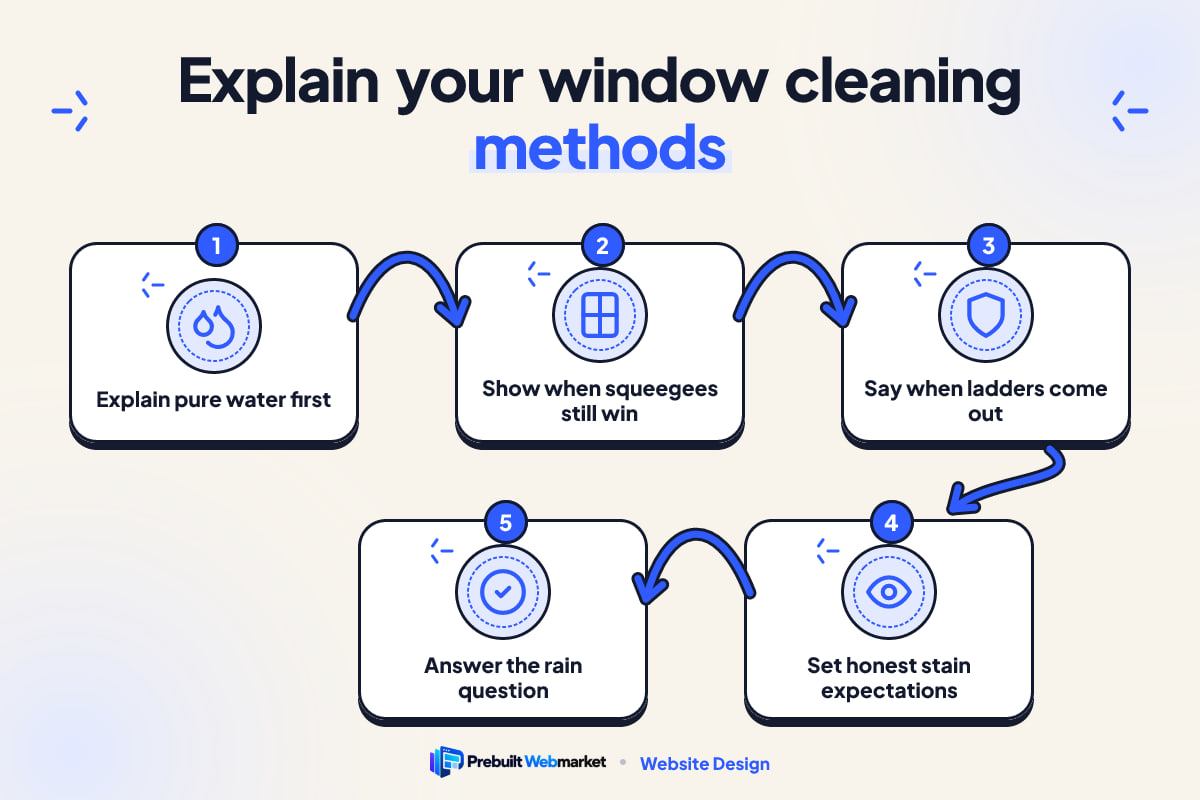
Explain each cleaning method on your website in one plain paragraph: what it is, why you use it and what the customer will see on the day. Lead with the result, not the kit. Say that pure water dries clear because the minerals are removed, that squeegees and ladders still have a place, and what you do about rain, stains and interiors.
Key takeaways
- Homeowners judge a method by what it looks like from the kitchen window, so describe the result before the equipment.
- Pure water is the idea most visitors need explained: the minerals that leave spots are filtered out, so the glass dries clear without wiping.
- Say plainly when you still use a squeegee or a ladder, such as interiors, heavy grime and glass you cannot reach from the ground.
- Answer the rain question and the hard water stain question on the page, because those are the two worries that come up most often on quotes.
- Define jargon such as RO, DI and TDS the first time you use it, or leave it off the customer page altogether.
- Start with one methods section on your services page; add separate pages only for methods that change the price or the booking.
In this article
- Using this guide to window cleaning website methods
- Water-fed pole cleaning
- Purified water, explained without the chemistry
- Traditional squeegee work
- Ladder work and working at height
- High-rise access, lifts and rope work
- Frames, sills, screens and tracks
- Hard water stains and glass restoration
- The rain question
- Solar panels and other glass
- Describing methods on your website without sounding defensive
- What to leave off the methods page
- Which ones you need first
- Questions to ask your web provider
- Your next step
- Frequently asked questions
The right way to present window cleaning website methods is one plain paragraph per method: what it is, why you use it, and what the customer will see on the day. Lead with the result, then the equipment. A homeowner who reads “we clean with purified water, so your glass dries clear without wiping” understands the job; one who reads “WFP with 0 ppm DI water” does not.
This matters more for window cleaners than for most trades because your best method often looks like the laziest one. A technician standing on the lawn with a long pole and no squeegee can look, to someone who grew up watching a ladder and a bucket, like a corner being cut. If your website explains the method before the van arrives, that same scene reads as modern, careful and safe. This field guide takes each method and term in turn so you can describe them with confidence, or brief the person building your site.
Using this guide to window cleaning website methods
This guide is a reference: each section covers one method or term a customer will meet, what it means, when it applies to your work, and what good copy about it looks like. Read the entries for the methods you actually use and skip the rest. Nothing here asks you to change how you clean; it is about how you describe it.
Each entry follows the same pattern:
- What it is, in one or two sentences a homeowner would understand.
- When it applies, so you can tell which jobs it fits and which it does not.
- What good looks like on the page, with an example line you can adapt.
The examples of customer copy in this article are illustrative. They are not taken from any real business, and you should rewrite them in your own voice with your own details.
A note on reading level before you start. The W3C’s guidance on WCAG reading level says content should be written “as clearly and simply as possible”, and that text using “short, common words and short sentences” is easier to read. That is the standard to aim for on a services page. Your customers are not cleaners; they want to know their windows will look good and nobody will damage the garden bed.
If you want the wider picture of which pages a window cleaning site needs, our guide to window cleaning website features covers that. This article stays with the methods.
Water-fed pole cleaning
Water-fed pole cleaning is a method where a technician on the ground scrubs the glass and frames with a brush on the end of a long, hollow pole, then rinses everything with purified water that flows through the pole and out of small jets around the brush. There is no squeegee and no wiping. The glass is left wet and dries clear on its own.
Most residential window cleaners use it for exterior glass on homes up to a few storeys, because it removes the need to climb and covers frames and sills as well as the glass. It is also the method customers are most likely to misunderstand, so it deserves the most careful explanation on your page.
What the customer actually sees
Describe the visit from the customer’s side, because that is where the worry lives. They will see a technician on the lawn or driveway, a hose running from the van, a pole reaching up to the second floor, and windows that look soaking wet when the technician moves on. Without an explanation, “they left my windows wet” is a reasonable complaint.
Tell them in advance. An illustrative line: “Your windows will look wet when we finish. That is normal. We rinse with purified water, which dries clear without streaks, usually within the hour.” That one sentence prevents a call, a complaint and, sometimes, a bad review written before the glass has dried.
Why it is not the lazy option
Water-fed pole work is not a shortcut, and your page should explain why in terms of what the customer gets rather than how hard you work. The honest benefits are:
- Frames and sills get cleaned too. The brush scrubs the frame on every pass, which a squeegee clean usually leaves alone.
- No detergent residue. Pure water rinses everything off, so there is nothing sticky left to attract dirt.
- Fewer ladders against the house. Less chance of marks on gutters, fewer feet in garden beds, and less risk for the technician.
- Upper windows get the same attention as lower ones. The reach is the same from the ground.
Keep the tone factual. You do not need to criticise ladder cleaners or squeegee work to make the case; customers notice when a page is arguing with someone who is not there.
Purified water, explained without the chemistry
Purified water is ordinary tap water that has been filtered to remove the dissolved minerals and other solids that normally leave spots when water dries on glass. Because there is nothing left in the water to dry into a mark, the glass can be left wet. This is the idea that makes the whole water-fed pole method make sense, and most visitors have never heard it.
The simplest explanation compares it to something they already know. Many homeowners have seen white spots on a car after washing it with a hose, or on a shower screen. Those spots are minerals left behind when the water evaporates. Take the minerals out first, and the spots never form.
Reverse osmosis and deionisation
Reverse osmosis (RO) and deionisation (DI) are the two common ways window cleaners purify water, and they are often used together. RO pushes water through a fine membrane that holds back most dissolved solids. DI passes water through resin that captures the remaining minerals. Many vans carry one or both, with a tank of purified water ready for the day.
Do you need to mention RO and DI on your customer page? Usually not by name. The W3C’s guidance on unusual words in WCAG is to “provide definitions for technical jargon and unusual terms”, and it encourages this for specialised information meant for non-specialist readers. If you do use the terms, put the plain idea first and the acronym after it: “purified water (we use reverse osmosis and deionisation filters)”.
TDS readings
TDS, short for total dissolved solids, is the measure of how much mineral and other matter is in the water, and window cleaners check it with a small handheld meter. A low reading tells you the purification is working. It is a useful quality check for you and a mildly reassuring detail for a technically minded customer.
On a residential page, one sentence is enough: “We test our water before every job to make sure it is fully purified.” Leave the numbers off unless you also explain what they mean and why they matter. A number with no context makes the reader feel they are missing something.
Traditional squeegee work
Traditional squeegee cleaning is the method most people picture: the glass is wetted with a soapy solution using a washer (a sleeve on a T-bar, sometimes called a strip washer), then the water is drawn off with a squeegee and the edges are detailed with a cloth. It is fast and precise in skilled hands, and it remains the right method for many jobs.
Say clearly where you still use it. Customers trust a business that explains its choices more than one that claims a single method suits everything. The common cases are:
- Interior windows, where a pole and running water are not an option.
- Shopfronts and ground-floor commercial glass, where a crisp, dry finish is wanted straight away and the glass is within easy reach.
- Heavily soiled glass, such as after building work or long neglect, where hand work and the right products shift what a brush and rinse cannot.
- Delicate or treated glass, such as some tinted films and coated panes, where you want full control over pressure and contact.
How to describe a mixed approach
Most residential window cleaners use both methods on the same house, and your website should say so plainly. An illustrative line: “We clean the outside of your windows with purified water and a water-fed pole, and the inside by hand with a squeegee and lint-free cloths.” That tells the customer exactly what happens indoors, which is the part of the visit they care most about, because a stranger is in their home.
Then add the practical detail for interior visits: whether you use drop sheets, whether you move furniture or ask them to clear sills, and whether you remove shoes or wear covers. These small points do more for trust than any claim about quality.
Ladder work and working at height
Ladder work is still part of window cleaning, but on most homes it is now the exception rather than the routine. Ladders are used where a pole cannot reach or cannot clean well, such as some skylights, awkward angles over conservatories or verandas, very high gable windows, and interior stairwell glass.
Safety rules for working at height in the United States and Australia generally push businesses to reduce climbing where a safer method is reasonably practical. Exact obligations depend on the job and the jurisdiction, so check with OSHA in the US or Safe Work Australia and your state regulator before you describe your safety practices in any detail. Do not quote rules from memory on a public page.
What to say about ladders
Customers want two things from this section: reassurance that nobody will get hurt on their property, and reassurance that their house will not be damaged. Address both briefly. An illustrative line: “We clean from the ground wherever we can. When a window needs a ladder, we use stand-offs so nothing rests on your gutters, and our team is trained and insured for the work.”
Only write what is true for your business. If you carry public liability insurance, say so and be ready to send a certificate. If your team holds a specific safety qualification, name it. If you do not use stand-offs, do not mention them.
High-rise access, lifts and rope work
High-rise window cleaning uses access methods such as elevated work platforms, building maintenance units (cradles fixed to the roof) and rope access, where a qualified technician works suspended from ropes. These are specialist methods for commercial and multi-storey buildings, and the buyer is usually a property manager or facility manager rather than a homeowner.
If you offer this work, give it its own commercial page rather than a paragraph on the residential one. The questions are completely different: method statements, insurance levels, certifications, roof anchor inspections, scheduling around tenants and building access. A commercial-first site like our HighRise Glass Services demo in Detroit, which covers high-rise, storefront and solar glass on contract schedules, shows how that buyer expects technical detail to be presented up front.
If you do not offer high-rise work, say what height you do cover, such as “homes and buildings up to three storeys”. Being clear about your limits saves both sides a wasted quote.
Frames, sills, screens and tracks
Frames, sills, screens and tracks are the parts around the glass, and customers are often unsure whether a window clean includes them. This is one of the most common sources of disappointment on a first visit, so your website should answer it explicitly for each method.
A water-fed pole clean usually covers exterior frames and sills as part of the job, because the brush scrubs them as it goes. A traditional squeegee clean often does not, unless you wipe frames by hand. Insect screens, sliding door tracks and interior sills are usually separate tasks with their own time and sometimes their own price.
A simple inclusion list
The clearest format is a short list under each service:
- Included: exterior glass, exterior frames and sills (pole clean); interior glass (hand clean, if booked).
- Add-on: insect screens, door and window tracks, interior frames and sills.
- Quoted separately: hard water stain removal, post-construction cleaning, skylights that need a ladder.
The MDN guide to the details element describes a disclosure widget that shows information only when it is opened, which is a tidy way to tuck the full inclusion list under each service without crowding the page. Do not hide the main answer that way, though. “Frames and sills included” should be visible without a tap.
Hard water stains and glass restoration
Hard water stains are mineral deposits that have built up on glass over time, usually from sprinklers, poorly placed downpipes or years of tap water drying on the surface. They are not the same as ordinary dirt, and a regular clean, with any method, often will not remove them.
This is where pure water cleaning gets an unfair reputation. A homeowner books a water-fed pole clean, the windows come up bright, but the cloudy patches by the sprinkler are still there. They conclude the method does not work. In fact, purified water prevents new spots; it does not dissolve deposits that have been building for years.
How to set expectations
State it before the booking, not after. An illustrative line: “Our regular clean removes dirt, dust and new water spots. Stains that have built up over years, often from sprinklers, need a separate restoration treatment. We will point them out on your first visit and quote before we do anything.”
Present stain removal as its own service with its own description, photos and quote path. It is skilled work with dedicated products and tools, and there is a real risk of damage to some glass if it is done badly. Being honest that results vary, and that some etched glass cannot be fully restored, is better than a refund conversation later.
The rain question
The rain question is the one most window cleaners hear every week: “Will you still come if it rains, and will it ruin the clean?” Your website should answer it on the services page and in the FAQ, in your own words, with your actual policy.
The usual explanation for pure water cleaning is that rain falling on clean glass leaves far less marking than rain falling on dirty glass, because much of the spotting people see after a shower comes from the dirt already on the window. Many pure water cleaners therefore work through light rain. Heavy rain, high wind and storms are a different matter, for both safety and results.
Write down what you do and stick to it:
- Light rain: whether you continue, and why.
- Heavy rain or wind: whether you postpone, and how you tell the customer.
- A spoiled result: whether you offer a free return visit within a set number of days.
If you offer a rain guarantee, make the conditions clear and short. A vague promise causes more arguments than no promise at all.
Solar panels and other glass
Solar panel cleaning is a related service that many window cleaners offer using the same pure water equipment, often with softer brushes and lower water flow. It deserves a short entry of its own on your website if you do it, because the customer is a different person with a different question: “Will cleaning damage my panels or void the warranty?”
You cannot answer that question for every panel brand, so do not try. Tell the customer to check their panel manufacturer’s cleaning guidance, describe the method you use, and say whether you work from the ground or need roof access. Our Crystal Coast Window and Solar demo in Wilmington, which covers window, solar panel and coastal glass care priced by pane count, is an example of a site that treats solar as its own line of work rather than a footnote.
Conservatory roofs, glass balustrades and glass pool fences fit the same pattern. If you clean them, give each a line saying which method you use and anything the customer should know about access.
Describing methods on your website without sounding defensive
Describing methods well comes down to three habits: lead with the result, explain the reason in one sentence, and never argue with an imaginary critic. Defensive copy usually comes from owners who have answered “but don’t you need a squeegee?” a hundred times, and it shows.
Compare two illustrative versions of the same paragraph.
Defensive: “Some people think water-fed poles don’t clean properly. That’s a myth. Pure water is actually better than traditional methods and anyone who tells you otherwise doesn’t understand the technology.”
Confident: “We clean the outside of your windows from the ground with a water-fed pole and purified water. The brush scrubs the glass and frames, then the pure water rinses everything away and dries clear, without streaks or spots.”
The second version never mentions the doubt, and it does not need to. It answers the doubt by explaining what happens.
Show it rather than claim it
A short video of a pole clean on a real house, and a before-and-after photo of a frame, do more than any paragraph. The MDN guide to the video element notes that videos should provide captions and transcripts, and that automatic captions should be reviewed for accuracy. If you narrate the clip, check the captions say “deionised” and not something stranger.
For photos, the W3C’s guidance on WCAG non-text content asks for a text alternative for visual content, so people who cannot see the image still get the information. Write alt text that describes the point of the photo, such as “Technician cleaning second-floor windows from the lawn with a water-fed pole”, not “window cleaning image”.
Tell machines what you offer
Search engines and AI assistants read your page differently from a homeowner, and they benefit from structure. Schema.org’s Service type describes “a service provided by an organization”, with a serviceType property for the kind of service. Marking up each service you offer, such as residential window cleaning, solar panel cleaning or hard water stain removal, helps those systems match your website to what people ask. It will not replace clear writing; it labels it.
What to leave off the methods page
Leaving things off is as important as what you include, because every extra paragraph pushes the quote button further down. These are the usual candidates to cut:
- Equipment brand names and specifications. Pole lengths, pump models and filter brands matter to other cleaners, not to homeowners.
- Unexplained numbers. A TDS reading or a water pressure figure with no explanation reads as noise.
- Comparisons with competitors. “Unlike other companies” invites the reader to go and check the other companies.
- Long histories of the method. Nobody booking a clean needs to know when pure water systems were invented.
- Promises about how long the glass will stay clean. Weather, trees and traffic decide that, not you.
If you want a page for equipment enthusiasts, put it on your blog. A methods article written for curious customers can earn search traffic without slowing down the people who just want a quote.
Which ones you need first
The entries you need first are the ones that cause questions on your current quotes. For most residential window cleaners, that means four, in this order:
- Water-fed pole cleaning, with the wet-window explanation.
- Purified water, in one plain paragraph.
- Interior hand cleaning, with what happens inside the home.
- The rain question, with your actual policy.
Add hard water stains next if you work in areas with sprinklers or hard water, then ladders and screens. Commercial access methods and solar belong on their own pages only when you sell those services. A website for a window cleaning company that starts with residential and commercial pages already has natural homes for each of these sections.
The goal is not a long methods page. It is a services page where every common doubt is answered in the place the customer would look for it, close to the quote button. For how that page fits into the rest of the site, our complete window cleaning websites guide walks through the full structure.
Questions to ask your web provider
The questions to ask your web provider are about whether the site can hold this content well, not whether it looks attractive in a demo. Whether you hire a freelancer, use an agency or start from a prebuilt window cleaning website, these are worth asking before you sign:
- Can each service have its own methods section, inclusion list and FAQ? A single generic services page with three bullet points will not hold it.
- Can I add short videos with captions without slowing the page? Ask how video is loaded and whether it affects page speed scores.
- Will my services be marked up with schema? Ask which types are used and whether FAQ content is marked up too.
- Can I edit the rain policy and add-on prices myself, or do edits go through you? Policies change; you should not wait a week to update one line.
- Will the booking confirmation repeat key points from the methods page? The wet-window line belongs in the confirmation as well.
- How fast does the site load on a phone? Most homeowners will read your methods section on a mobile, often on the evening before the visit.
You can weigh the different routes in our comparison of website options, which sets prebuilt sites against DIY builders, WordPress, freelancers and agencies, because each suits a different owner.
If you want a starting point that already has residential and commercial pages and a per-pane quote calculator, our window cleaning designs come with that structure and you add the methods copy in your own words. Plans start at $97 a month with $297 setup, launch within 7 business days of receiving your content, and are guaranteed to score 100 for on-page SEO and 95+ for performance at launch. You can see everything included on our plans and pricing page.
Your next step
Pick the one method customers ask you about most and write its paragraph today: what it is, why you use it and what they will see. Put it on your services page and in your booking confirmation. Then do the same for the rain question.
If you would rather talk through how a methods section fits your site, book a free 45-minute call and we will look at your current services page with you. Or browse our window cleaning website demos to see how the residential and commercial pages are laid out, starting with the ClearView Window Co. demo in Sacramento.
Sources
Frequently asked questions
Should my window cleaning website explain the water-fed pole method?
Yes, if you use it on homes. Many homeowners have never seen pure water cleaning and assume that no squeegee means a quicker, poorer job. A short explanation of what the pole does, why the water dries without spots and what they will see on the day stops that worry before it becomes a phone call or a lost quote.
Is a water-fed pole as good as hand cleaning?
For exterior glass and frames on most homes, a well-run pure water system gives an equal or better finish, because it cleans the frames as well as the glass and leaves no detergent behind. Hand work with a squeegee is still better for interiors, delicate glass, heavy grime and some coated or tinted panes. Say both of those things on your page.
What should I say on my website about cleaning in the rain?
Say what you actually do. Most pure water cleaners work through light rain, because the glass is already rinsed with purified water and rain falling on clean glass usually dries with far less marking than rain on dirty glass. Explain your policy for heavy rain, wind and storms, and whether you offer a free return visit if the result is spoiled.
Can pure water remove hard water stains from windows?
Usually not. Pure water prevents new mineral spots, but stains that have etched or bonded to the glass over months or years need restoration work with dedicated products and hand tools. Your website should say this clearly and present stain removal as a separate, quoted service, so customers are not disappointed after a regular clean.
Do I need a separate page for each window cleaning method?
Not at first. One clear methods section on your residential services page covers most homeowners. Add a separate page when a method changes the price, the booking or the type of customer, such as high-rise access for commercial buildings, solar panel cleaning or hard water stain restoration.
Should I use terms like RO, DI and TDS on my window cleaning website?
Only if you explain them. Most homeowners do not know what reverse osmosis, deionisation or total dissolved solids mean, and unexplained acronyms make a page feel like it was written for other cleaners. Use the plain idea first, purified water with the minerals removed, then add the technical term in brackets for the customers who want it.
Should I show videos of my cleaning methods?
A short clip of a pole at work on a real house answers more questions than a paragraph. Keep it under a minute, film on a bright day, add captions for any speech, and describe what the video shows in the text beside it so the page still makes sense with the video off.