
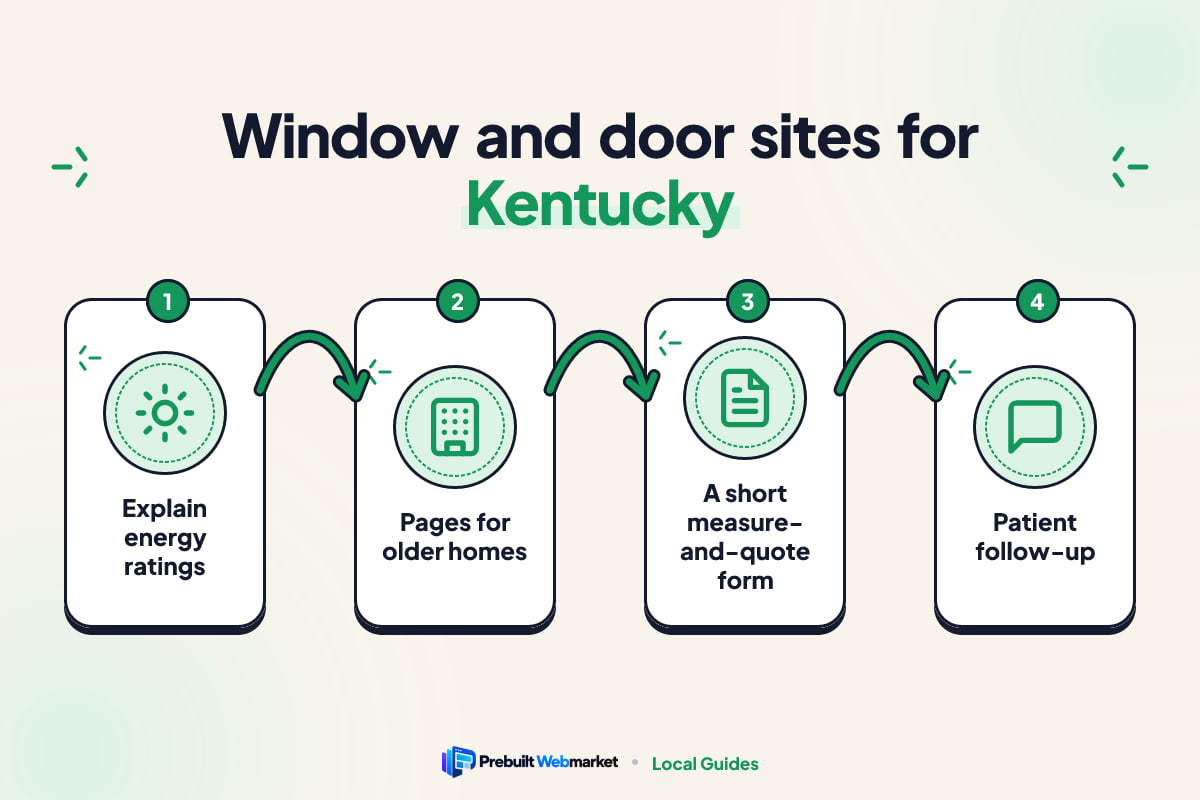
Quick answer
A Kentucky window and door website should book a free measure-and-quote visit from a phone in under two minutes, explain glazing and energy ratings for a climate with hot, humid summers and cold winters, show real installs in Louisville, Lexington and Bowling Green, and handle older homes and historic districts honestly. A prebuilt design launches in about 7 days from $97 a month.
Key takeaways
- Kentucky homes need windows that cope with both summer cooling and winter heating, so your website should explain U-factor and solar heat gain in plain words, not just list brands.
- Much of the work in Louisville and Lexington is in older homes. Pages on historic districts, lead-safe work in pre-1978 houses and original wood windows win trust that a generic site cannot.
- A measure-and-quote request form, visible on every page and short enough to finish on a phone, matters more than any design detail.
- Build one real page for each area you serve, written about the homes there, not one list of place names.
- Window buyers compare for weeks. Fast first replies and patient follow-up decide who gets the job.
- A prebuilt windows and doors website costs from $97 a month plus $297 setup and launches within 7 business days of receiving your content.
In this article
- How do Kentucky homeowners shop for windows and doors?
- Windows & doors website design in Kentucky: the pages to build
- Older homes, historic districts and lead-safe work
- Area pages for Louisville, Lexington and Bowling Green
- How long does a window buyer take to decide, and what does that mean for your website?
- Local SEO and AI search for Kentucky window companies
- Following up a measure-and-quote request
- What a windows and doors website costs: options compared
- Six mistakes Kentucky window and door websites make
- A 90-day plan for a Kentucky window and door company
- How PrebuiltWebMarket helps Kentucky window and door companies
- Your next step
- Frequently asked questions
Windows & Doors website design in Kentucky comes down to one job: turning a homeowner who is quietly comparing three companies into a booked measure-and-quote visit. The site that wins makes that visit easy to request from a phone, explains glass and energy ratings in plain words for a state with hot, humid summers and cold winters, shows real installs in Louisville, Lexington and Bowling Green, and is honest about older homes, historic districts and lead-safe work.
This guide is for owners of window and door companies across Kentucky, from one-crew installers to showrooms with a sales team. It covers how Kentucky homeowners shop, the pages and features your website needs, area pages, search and AI visibility, follow-up, costs and a 90-day plan.
How do Kentucky homeowners shop for windows and doors?
Kentucky homeowners usually shop for windows and doors slowly and carefully. They notice a draft, a foggy pane, a sticking door or a high utility bill, then spend weeks reading, comparing and asking neighbors before they book two or three in-home quotes. Your website has to earn one of those visits.
That slow, considered purchase shapes everything below. Four Kentucky conditions make it more specific.
A climate that works both sides of the glass
Kentucky has hot, humid summers and cold winters, so homes run air conditioning for months and heating for months. A window that only blocks winter heat loss, or only cuts summer sun, is half the story. Homeowners here benefit from understanding both U-factor and solar heat gain, and very few installer websites explain either in words a homeowner can follow.
That is an opening for you. A clear page that says which glass packages you recommend for south and west facing rooms, and why, reads as expertise rather than a sales pitch.
Old houses in Louisville and Lexington
Louisville has large neighborhoods of older homes, including Old Louisville’s Victorian streets, the Highlands, Crescent Hill and the shotgun houses of Germantown. Lexington has its own older neighborhoods close to downtown and the University of Kentucky. Many of these homes have original wood windows, odd sizes, plaster walls and painted trim.
Owners of these homes have specific worries: will new windows look wrong, will the trim be damaged, is the work safe with old paint, and does the house sit in a district where changes need approval? A website that answers those questions directly speaks to a profitable group of customers that most competitors ignore.
Postwar ranches and new subdivisions
Outside the older cores, a lot of Kentucky housing is postwar ranches and split-levels, often with ageing aluminum or early vinyl windows, plus newer subdivisions around Louisville’s suburbs, the towns ringing Lexington and the growth around Bowling Green. These owners want something different: a straightforward full-house replacement, clear financing, and a crew that finishes in a day or two.
Your site should have a path for each group, not one generic “replacement windows” page trying to talk to both.
Spring storms and urgent repairs
Kentucky gets severe spring and summer storms, and the December 2021 tornadoes that struck western Kentucky, including parts of Bowling Green, are still in local memory. After a storm, people search for broken glass repair, board-up help and door replacement the same day. If you take that work, a clear storm and glass repair page with a phone number at the top captures it. If you do not, say so, so you are not answering calls you cannot help with.
Windows & doors website design in Kentucky: the pages to build
A window and door company website needs a short list of pages, each with a clear job. The table below lists them, what each one is for and what a Kentucky company should put on it.
| Page or feature | What it is for | What to include in Kentucky |
|---|---|---|
| Measure and quote form | Turns a visitor into a booked visit | ZIP code or town, number of windows or doors, product interest, preferred day, photos optional |
| Windows page | Ranks for window searches and explains choices | Replacement and new construction, frame materials, styles, typical lead times |
| Doors page | Captures entry, patio and storm door searches | Entry doors, sliding and French patio doors, storm doors, security and weather sealing |
| Glazing and energy page | Answers the questions that delay a decision | U-factor and solar heat gain in plain words, double and triple glazing, low-E coatings |
| Gallery | Proves the result | Before and after photos tagged by town and home type |
| Service areas | Ranks in each city and suburb | One page each for the areas you really serve |
| Older homes page | Wins historic and pre-1978 jobs | Matching sightlines, trim care, lead-safe practices, district approvals |
| Reviews and About | Answers “can I trust these people in my house?” | Years in business, insurance, warranty terms, named installers |
The measure-and-quote request form
This is the most important feature on the site. Nobody buys windows online, but they will happily request a visit if it is quick. Ask for the town, roughly how many windows or doors, what they are interested in and a preferred day. Let people attach a photo of the problem window if they want to.
Put a button to the form at the top of every page, after every product section and in a fixed bar on phones. Then reply fast, which is covered in the follow-up section below.
Product range pages that help people choose
A page that lists brand names and “quality products” does not help anybody. A good windows page explains the choices a homeowner actually faces: vinyl, fiberglass, wood or clad wood frames; double-hung, casement, sliding and picture windows; full-frame replacement or insert replacement. Say which you recommend for which situation and why.
Do the same for doors. Entry doors are partly about looks and partly about security and drafts. Patio doors are about how the room is used. Storm doors matter in older Kentucky homes with original entry doors. Each deserves a section, and the main ones deserve their own page.
An energy and glazing explainer
The NFRC label on a window shows its ratings. U-factor measures how well a window keeps heat from escaping, where lower is better. Solar heat gain coefficient measures how much of the sun’s heat comes through, where lower means less summer heat. Visible transmittance shows how much daylight gets through.
Explain these with a labelled photo of a real label and one or two sentences each. Then say what you usually recommend in Kentucky homes and why. Avoid promising a specific saving on energy bills: it depends on the house, the old windows and how the home is heated and cooled.
A gallery tagged by place and home type
Photos sell windows. Tag each project with the town and the type of home: “full-house vinyl replacement, 1960s ranch, Jeffersontown” or “wood-clad double-hungs, Highlands bungalow, Louisville”. A visitor in Bowling Green with a 1990s two-story home wants to see a home like theirs, and search engines read those captions too.
Our Northlight Windows and Doors demo, set in Adelaide, shows this layout in practice: a clean, bright design with separate window, door and double glazing pages, a project gallery and a quote request on every screen. For a Kentucky company the same structure is customised with your products, photos and towns.
Older homes, historic districts and lead-safe work
This section is where a Kentucky window website can stand out most, because few competitors handle it well. If you work on older homes, give it its own page and link to it from your Louisville and Lexington pages.
Historic districts and design review
Louisville and Lexington both have locally designated historic districts where exterior changes, including windows and doors, can need approval before the work starts. In Louisville this runs through Louisville Metro’s historic preservation and landmarks process; in Lexington, through the city’s historic preservation office and its Board of Architectural Review.
Do not quote rules or timelines from memory on your website. Instead, explain the process in general terms: some homes need approval, approvals take time, and the design may need to match the original. Then say what you do to help, such as providing product drawings and photos for an application. Tell readers to confirm with the city before they sign.
Lead-safe work in pre-1978 homes
A federal EPA rule covers renovation work that disturbs paint in homes built before 1978, and removing old windows usually does. Firms doing that work for pay generally need to be certified and follow lead-safe practices. If your company is certified, say so plainly on the older homes page and on your About page, and explain what lead-safe work looks like on the day: plastic sheeting, containment, careful clean-up.
Many homeowners in older Louisville and Lexington neighborhoods have heard about lead but do not know the rules. A calm, factual explanation builds trust. Check the current requirements with the EPA before publishing, and never claim certification you do not hold.
Repair, restore or replace?
Some owners of older homes want to keep original wood windows. If you restore windows or add storm windows, say so. If you do not, explain honestly when replacement makes sense and how you match the look. A page that admits “replacement is not always the answer” is more persuasive than one that pretends it always is.
Area pages for Louisville, Lexington and Bowling Green
Most window and door searches include a place: “window replacement Louisville”, “entry doors Lexington KY”, “patio door installers Bowling Green”. Search engines decide who to show partly by how clearly your website is tied to that place. One page with a paragraph of forty town names does not do that. A real page for each area does.
The table below shows how the angle changes across the areas a Kentucky company commonly serves.
| Area | Typical homes | What the page should lead with |
|---|---|---|
| Louisville core (Highlands, Old Louisville, Crescent Hill, Germantown) | Victorian homes, bungalows, shotgun houses | Wood and clad-wood options, sightline matching, historic district help, lead-safe work |
| Louisville suburbs (St. Matthews, Jeffersontown, Middletown, Prospect) | Postwar ranches, 1970s to 1990s two-story homes | Full-house replacement, patio doors, financing, short install times |
| Lexington | Older homes near downtown and the university, newer subdivisions on the edges | Both paths: older home care and straightforward replacement |
| Towns around Lexington (such as Georgetown, Nicholasville, Richmond) | Newer builds and growing subdivisions | Builder-grade window upgrades, entry door upgrades, storm doors |
| Bowling Green and Warren County | Mix of older town homes, student rentals and newer builds | Replacement for homeowners and landlords, storm and glass repair |
Only build pages for places you serve today. If you cross the river into southern Indiana, a page for those towns makes sense; if you drive there twice a year, it does not.
What makes an area page worth reading
A useful area page could not be copied to another town by swapping the name. Describe the homes you see there, the products people usually choose, any local permit or district step, typical lead times, and two or three recent projects with photos. Add a short FAQ for that area and the quote form. A few hundred words of real detail beats a thousand words of filler.
Our page on what we build for businesses in Kentucky shows how we handle area pages across the state, and our Nomad Long Distance Movers demo set in Louisville is an example of a site written around a Kentucky city, in a different trade.
How long does a window buyer take to decide, and what does that mean for your website?
Window and door buyers often take weeks, sometimes months, from first search to signed contract. They compare several companies, wait for a tax refund or a quieter season, and talk it over at home. Your website has to keep earning their trust across several visits, not just the first one.
That changes what the site should do.
Give them something to come back for
A first-time visitor may not be ready to book a visit. Give them a reason to stay in touch: a short buyer’s guide to frame materials, a page comparing double and triple glazing, or a checklist of questions to ask any installer. Each of these is a page they can bookmark and a page that can rank in search.
Make the price conversation honest
Homeowners hate the feeling of a sales visit that ends with a huge number. Show typical ranges for common jobs, explain what changes the price (size, frame, glass, trim work, access) and say whether your quote is fixed. Mention financing if you offer it, and the terms in plain words.
Small conversion changes add up
Conversion rate is the share of visitors who request a visit. The chart below is a worked example using round numbers: 600 visitors a month at different conversion rates.
- 61% convert
- 122% convert
- 183% convert
- 244% convert
Example only. Your traffic and rates will differ.
Source: Illustrative arithmetic: 600 visitors multiplied by each conversion rate
In this example, moving from 1 in 100 visitors requesting a visit to 3 in 100 triples the requests without a single extra visitor. A short form, clear ranges, visible reviews and a fast site are what move that number. Our guide to website speed for local businesses explains why the last one matters so much on phones.
Local SEO and AI search for Kentucky window companies
SEO, search engine optimisation, is the work of helping your business appear when people search. For a window and door company it is almost entirely local. Do it in this order.
1. Complete your Google Business Profile
Your Google Business Profile is the listing in Google Maps and the map results. Choose the most accurate primary category, list your products as services, set your service areas, add real install photos and keep hours current. Your business name, address and phone number must match your website exactly.
2. One page per product and per area
Separate pages for replacement windows, entry doors, patio doors and storm doors, plus the area pages above, give search engines a clear match for each search. Each page needs a title that names the product and place, and content written for a homeowner.
3. Reviews that mention the job and the town
Ask every customer for a review once the install is finished and cleaned up, by text, with a direct link. A review that says “replaced eleven windows in our Lexington ranch in one day” helps more than “great job”. Reply to every review.
4. Answer questions for AI assistants
More homeowners now ask ChatGPT, Gemini, Perplexity or Google’s AI Overviews questions such as “who replaces windows in older homes in Louisville?”. AEO, answer engine optimisation, means structuring content so it can be shown as the direct answer. GEO, generative engine optimisation, means making your business easy for AI models to understand and cite. Our explainer on what AEO and GEO mean covers both.
In practice: use question headings with a direct answer in the first two sentences, state what you install, where and roughly for how much, add LocalBusiness and FAQ schema (code that labels your details for machines), and keep your information identical everywhere it appears. Nobody can promise an AI recommendation; you can only remove reasons to be skipped.
5. Publish on a seasonal calendar
Window and door demand in Kentucky follows the weather. A blog lets you publish the pages people search for before each season. The table below is a simple calendar.
| Months | What homeowners search for | Article to publish |
|---|---|---|
| January to March | Drafts, condensation, high heating bills | “Why your windows fog up in a Kentucky winter, and when it means replacement” |
| April to June | Storm damage, spring projects | “Storm-damaged glass: what to do in the first 24 hours” |
| July to August | Hot rooms, summer cooling | “Which glass keeps a west-facing Kentucky room cooler” |
| September to October | Getting work done before winter | “How to get new windows installed before the first freeze” |
| November to December | Entry doors, holiday guests | “Choosing an entry door that seals out winter drafts” |
The same approach works in other home improvement trades. Our guides to bathroom remodeling websites in Indiana and kitchen remodeling websites in Delaware show how neighboring trades plan content around the consultation they want to book.
If you do not have time to write, our SEO blog package publishes two articles a week on your own site.
Following up a measure-and-quote request
A homeowner who asks three companies for a quote often books the first one that replies clearly and turns up when promised. Window jobs are large, so buyers are cautious, and a slow or vague reply looks like a sign of how the install will go.
A CRM, customer relationship management system, keeps track of every request, replies automatically and reminds your team to follow up. A simple sequence for a window and door company looks like this.
| When | What happens | Why it matters |
|---|---|---|
| Within 1 minute | Automatic text and email confirming the request, with two or three visit times | The homeowner knows you received it and stops shopping |
| Same business day | A person calls to confirm the visit and asks what prompted the enquiry | A human reply builds trust before you arrive |
| Day before the visit | Reminder with the estimator’s name and photo | Fewer no-shows, and a familiar face at the door |
| 2 days after the quote | Short check-in offering to answer questions | Many buyers have one question they did not ask |
| 2 weeks after the quote | Polite follow-up, plus a link to your energy explainer | Long decisions need a reminder, not pressure |
| After the install | Thank you, care instructions, warranty details and a review request | Reviews and referrals come from finished jobs |
The chart below is a worked example of why the first reply matters. It assumes 30 quote requests a month and shows how many become booked visits at different booking rates.
- 40% booked12
- 55% booked16.5
- 70% booked21
Example only. The rates are round numbers to show the arithmetic, not measured results.
Source: Illustrative arithmetic: 30 requests multiplied by each booking rate
In this example, the same 30 requests produce 9 more visits a month at a 70% booking rate than at 40%. Quick replies, clear visit times and reminders are what raise that rate. If a caller reaches voicemail, a missed-call text-back sends them a message straight away so they do not ring the next company. Only text people who have agreed to receive messages, and follow the rules for business texting.
Our Scale plan sets this up for you in GoHighLevel; the GoHighLevel CRM package page lists everything included. Our article on movers website follow-up with a CRM shows the same idea in another trade with long, comparison-heavy decisions.
What a windows and doors website costs: options compared
There are four realistic ways for a Kentucky window and door company to get a website. Each suits a different business. Our full comparison of website options goes into more detail.
| Option | Time to go live | Upfront cost | Who maintains it | Best for |
|---|---|---|---|---|
| Do-it-yourself builder | Weeks of your own time | Low | You | New installers with more time than budget |
| Freelancer | Usually 2 to 8 weeks | Medium to high | You, or the freelancer by the hour | Owners with a clear brief and time to manage it |
| Agency | Often 1 to 3 months | High | The agency, on a retainer | Large showrooms wanting a fully custom brand |
| Prebuilt website | About 7 days | $297 setup | We do, with monthly edits included | Owners who want a proven site quickly |
A DIY builder is a sensible start if you are just setting up and have evenings free. An agency makes sense for a multi-location dealer with a marketing team. Most owner-run installers sit in between, which is where a prebuilt site fits.
What our plans cost in the first year
PrebuiltWebMarket has three plans. Each includes a prebuilt design customised to your brand, hosting, SSL, daily backups and monthly edits, with no contract. The chart shows first-year cost on monthly billing, including the $297 setup fee.
- Launch ($97 x 12 + $297)$1,461
- Growth ($297 x 12 + $297)$3,861
- Scale ($497 x 12 + $297)$6,261
Yearly billing costs $970, $2,970 and $4,970 a year, plus the same setup fee.
Source: PrebuiltWebMarket pricing, 2026
Launch is the website: any prebuilt design customised to your brand, lead forms to email and SMS, Google Analytics 4 and 3 content edits a month. Growth adds the blog and search setup. Scale adds the CRM and unlimited edits. Every detail is on the plans and pricing page.
For context, a single full-house window replacement is usually a large job. If the website helps you win one extra job a year that you would otherwise have lost, it has very likely covered the Launch plan’s first-year cost of $1,461.
Six mistakes Kentucky window and door websites make
- A brand catalogue with no advice. Listing manufacturers does not tell a homeowner what to choose for their house.
- No path for older homes. Owners in the Highlands or near downtown Lexington leave when the site only shows new vinyl in a new subdivision.
- Energy claims you cannot back up. “Save 40% on your bills” invites distrust. Explain ratings and leave the promises out.
- A long, demanding quote form. Twelve required fields on a phone loses most people. Ask for the minimum.
- Stale tax credit or rebate claims. Federal credits for windows and doors have changed. Out-of-date claims damage trust and can mislead customers.
- Slow, heavy pages. Large gallery photos that are not compressed make the site crawl on mobile data, and the gallery is exactly what buyers want to see.
A two-minute self-check
Open your website on your phone. Can you request a visit in under two minutes? Is there a page for your main city? Can you find an explanation of U-factor without searching? Is a recent review visible on the home page? If two or more answers are no, the site is costing you visits.
A 90-day plan for a Kentucky window and door company
You do not have to do everything at once. This plan puts the highest-value work first and times it to the Kentucky calendar.
- Days 1 to 7: launch. Go live with the quote form, windows and doors pages, the energy explainer and your main city page.
- Days 8 to 30: local presence. Complete your Google Business Profile, add area pages for your next two or three areas and start asking every finished customer for a review.
- Days 31 to 60: Kentucky-specific pages. Publish the older homes page, a storm and glass repair page if you take that work, and a gallery tagged by town and home type.
- Days 61 to 90: content and follow-up. Publish seasonal articles ahead of the next season, set up automatic replies and reminders, and check which pages bring quote requests.
If you are reading this in autumn, prioritise “before the first freeze” and entry door pages. If it is late winter, have storm and spring project pages ready before April.
How PrebuiltWebMarket helps Kentucky window and door companies
We build websites for local service businesses from designs that already exist and already work. You can open them and click through before you decide. There are 113 live demos across 29 industries on our website designs page.
For window and door companies, the prebuilt windows and doors website is built around the pages this guide recommends: Home, Windows, Doors, Double Glazing, Gallery, Service Areas and Get a Quote, with a measure-and-quote request form, product range pages, an energy rating and glazing explainer and a project gallery. Northlight Windows and Doors, the Adelaide demo mentioned earlier, is the live example.
Here is what happens when you choose one:
- You pick a design and book a call.
- We customise it with your logo, colors, products, photos and the Kentucky areas you serve, using American spelling and terms throughout.
- We launch it within 7 business days of receiving your content, on your own domain.
- We look after it. Hosting, SSL, daily backups and your monthly edits are included.
Every site is guaranteed to score 100 out of 100 for on-page SEO and 95 or more for PageSpeed performance at launch. If you are not happy, the first month is refunded within 30 days. Plans are month-to-month, and you keep your domain, content and leads. We do not promise rankings or a number of leads; we build a fast, clear site and give you the tools to follow up well.
If you are also weighing up a roofing or exterior trade, our guide to roofing websites in North Carolina covers storm pages in more depth.
Your next step
If your current website lists brands without advice, has no page for older homes or your main city, or makes people fill in a long form to get a quote, it is sending Kentucky homeowners to the next company on their list.
Open the windows and doors website demos and click through Northlight to see how the pages fit together. Then book a free 45-minute call and we will tell you honestly whether a prebuilt site fits your company. If you would rather write, use our contact form.
Frequently asked questions
How much does a windows and doors website cost in Kentucky?
It depends on how it is built. A do-it-yourself builder costs little each month but takes your own time. Freelancers and agencies usually charge more up front for a custom build. A prebuilt windows and doors website from PrebuiltWebMarket costs from $97 a month plus a $297 one-time setup fee, with hosting, SSL, daily backups and 3 content edits a month included. The first year on the Launch plan comes to $1,461.
What pages should a window and door company website have?
Start with Home, Windows, Doors, Glazing and Energy, Gallery, Service Areas, About, Reviews and Get a Quote. Give each main product its own page, such as replacement windows, entry doors, patio and sliding doors and storm doors, and put a measure-and-quote button on every page. Kentucky companies should also add a page on older and historic homes if they do that work.
Do window installers need a license in Kentucky?
Kentucky does not issue one general license that covers every window and door installer, but cities and counties can require business licenses, registrations or permits, and some trades such as electrical work are licensed by the state. Rules change and vary by place, so confirm with Louisville Metro, Lexington-Fayette Urban County Government or your local office before you publish any licensing claim.
Should my window website show prices?
Show what you honestly can. Exact prices depend on sizes, frame material, glass and installation, so most companies cannot price a whole house online. You can still give starting prices or typical ranges for a standard replacement window, an entry door and a patio door, and explain what moves the price. Visitors who see a range trust you more than visitors who see nothing.
How do I explain energy ratings on my website?
Use the label your customers will see. Explain that the NFRC label shows U-factor, which measures how well a window keeps heat in, and solar heat gain coefficient, which measures how much sun heat comes through. In Kentucky both matter because summers are hot and winters are cold. Keep it short, use a labelled photo, and avoid promising a specific saving on energy bills.
Do I need separate pages for Louisville, Lexington and Bowling Green?
Yes, if you genuinely work in each. A page for each area that describes the homes you see there, the products people ask for, any historic district steps and recent local projects gives Google and AI assistants a clear reason to show you for searches in that place. Do not create pages for places you do not serve or copy one page with the city name swapped.
How do I get my window company recommended by ChatGPT or Google AI Overviews?
Make your website easy to quote. State what you install, where and roughly what it costs in plain sentences, answer common questions under question headings, add LocalBusiness and FAQ schema, keep your name, address and phone identical everywhere, and collect genuine reviews that mention the product and town. Nobody can guarantee an AI recommendation, but clear, consistent and fast pages give you the best chance.
How long does it take to launch a windows and doors website?
A custom build often takes one to three months. A prebuilt design already exists and is customised with your logo, products, photos and service areas, so it can launch in about 7 days. PrebuiltWebMarket guarantees launch within 7 business days of receiving your content, and every plan is month-to-month with a 30-day money-back guarantee on the first month.
Can my website mention federal tax credits for windows and doors?
Only with care. Federal energy credits for windows and doors have changed several times, and the rules that applied in earlier years may not apply now. If you mention any credit, rebate or utility program, link to the official source, say who qualifies, date the page and check it every few months. It is safer to say you can help customers check than to promise a credit.