
Quick answer
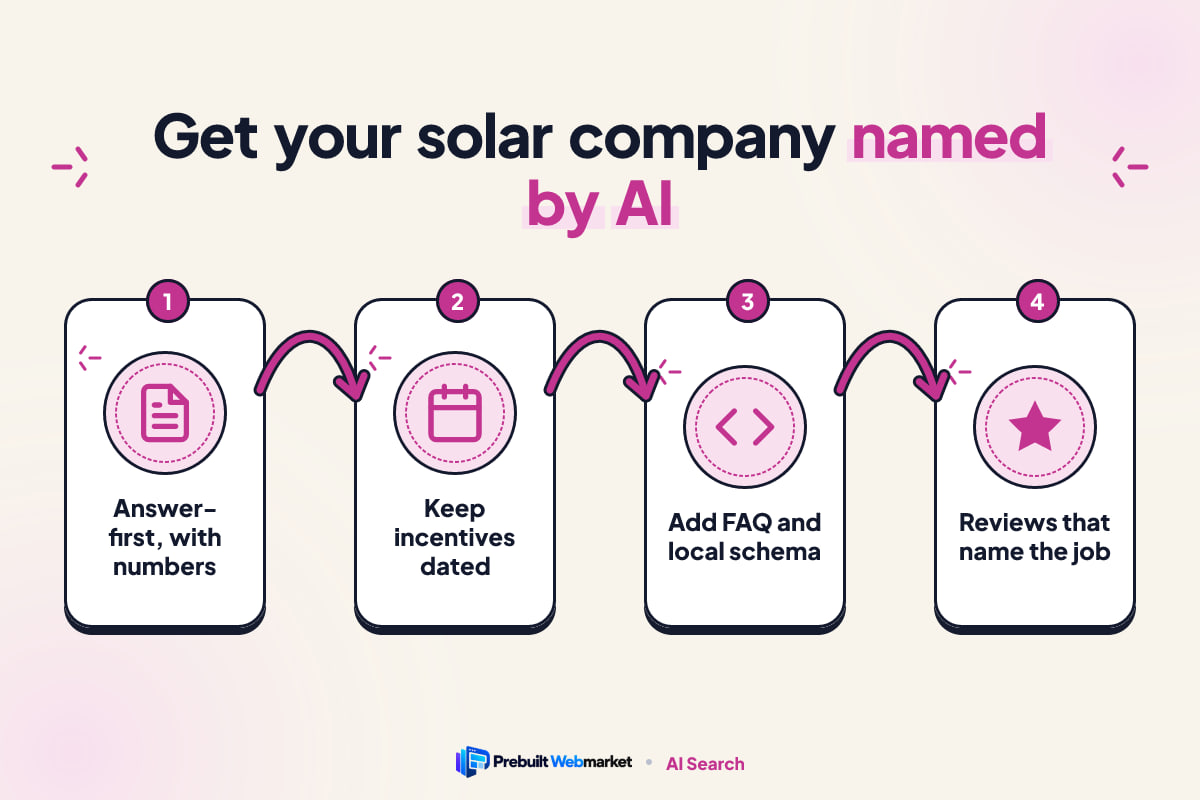
A solar installer gets recommended by AI search when its website answers homeowner questions directly, with real numbers and stated assumptions, uses FAQ and LocalBusiness schema, keeps business details identical everywhere, earns reviews that name the system installed, and loads fast as plain, crawlable text. Nobody can guarantee a citation, but these steps remove the reasons an AI tool would skip you.
Key takeaways
- Solar buyers research for weeks and ask AI tools long, specific questions about savings, batteries and incentives. Your pages should answer those questions in the first two sentences.
- Put numbers, units and assumptions on the page in plain text. A savings figure hidden inside a calculator script cannot be read or quoted.
- Keep incentive pages dated and current. Federal, state and utility incentives change, and pages that still promise an expired incentive damage trust.
- Use FAQ, LocalBusiness and Service schema, and keep your name, address, phone and service list identical on every profile.
- Ask for reviews that mention the system size, battery and town. AI tools lean on what customers say, not only on what you say.
- Test 10 to 15 real customer questions in ChatGPT, Gemini, Perplexity and Google every month and track whether you appear.
In this article
- What is AI search optimization for a solar company?
- Why AI search matters more in solar than in most trades
- What do solar customers ask AI assistants?
- How do AI assistants decide which solar installer to mention?
- The solar website pages AI tools can actually use
- Step 1: Write answer-first website pages with real numbers
- Step 2: Add FAQ and schema markup
- Step 3: Make your business details identical everywhere
- Step 4: Earn reviews that describe the job
- Step 5: Keep your solar website fast and crawlable
- Step 6: Publish helpful solar content on a schedule
- Following up when an AI-referred lead books
- How to measure whether AI search is working
- What does solar energy AI search optimization cost?
- Seven AI search mistakes solar companies make
- A 90-day AI search plan for a solar installer
- How PrebuiltWebMarket helps solar installers
- Your next step
- Frequently asked questions
Solar energy AI search optimization means making your website the clearest, most trustworthy answer when a homeowner asks ChatGPT, Gemini, Perplexity or Google AI Overviews a question about solar. In practice that comes down to six things: answer common questions in the first two sentences, put real numbers and assumptions on the page as plain text, add schema markup, keep your business details identical everywhere, earn reviews that describe the job, and keep the site fast and crawlable.
This guide is for owners of residential and commercial solar companies in the United States, whether you install 30 systems a year or 300. It explains AEO and GEO in plain English, shows the questions solar customers actually ask AI tools, gives a step-by-step plan with examples, and is honest about what nobody can promise.
What is AI search optimization for a solar company?
AI search optimization for a solar company is the work of making your pages easy for AI assistants to understand, trust and quote when someone asks about solar. It builds on normal SEO and adds two layers: AEO, which shapes content into direct answers, and GEO, which makes your facts and reputation clear enough to cite.
Three terms get mixed up, so here they are side by side.
| Term | Stands for | What it aims for | Solar example |
|---|---|---|---|
| SEO | Search engine optimisation | Ranking in Google and Bing results and the map pack | Ranking for “solar installer Fresno” |
| AEO | Answer engine optimisation | Being the direct answer in featured snippets, “People also ask” and voice | Your FAQ answer shown for “how long do solar panels last” |
| GEO | Generative engine optimisation | Being cited or recommended inside AI-written answers | ChatGPT naming you when asked for a reputable installer near Fresno |
If you want the general version of this explanation, our plain-English guide to what AEO and GEO mean covers it for any business. The rest of this article is about solar specifically, because solar has a few features that make AI search matter more than it does for, say, a locksmith.
How AI search differs from a normal Google search
A normal search returns a list of links and the person picks. An AI answer reads several sources, writes a summary and sometimes names a few businesses. The person may never see a list of ten websites at all. That changes the question you are trying to win. It is no longer only “am I on page one?” but also “when an AI tool summarises the options, is my business the one it trusts enough to mention, and does it describe me correctly?”
What stays the same
AI tools that search the web live still need to find, load and read your pages. If Google or Bing cannot crawl a page, an assistant drawing on them cannot use it either. So the boring basics, a fast site, clean headings, accurate titles and a sitemap, are still the foundation. GEO without SEO is a house without a slab.
Why AI search matters more in solar than in most trades
Solar is a large, considered purchase that people research for weeks before they talk to anyone. That is exactly the kind of decision people now take to AI assistants. Four things make it different from a quick-call trade.
Homeowners research long before they call
Nobody books a solar consultation the same afternoon a pipe bursts. A homeowner might first wonder whether solar makes sense when their summer bill arrives, read about batteries after an outage, and only contact installers months later. During that time they ask a lot of questions, and increasingly they ask them in a chat window. If your site has answered those questions clearly, your name is already familiar when they are ready.
The questions are long and specific
Solar questions are rarely two words. They sound like “is a 7 kW system enough for a house with an EV in the Central Valley” or “does my utility still pay full retail for solar I send back to the grid”. Those are the long, conversational queries AI tools are built for. A website with one generic “Residential Solar” page cannot answer them. A website with a clear page on batteries, a page on your local utility’s export rules and an honest FAQ can.
Trust is the whole sale
Solar has a reputation problem. Many homeowners have dealt with aggressive door-to-door sales, confusing leases or promises of a $0 power bill. When they ask an AI tool “how do I find a reputable solar installer”, the answer usually tells them to check licensing, certifications, reviews, warranties and how long the company has been around. Your site should make each of those easy to verify, because the AI tool is effectively coaching the customer to look for them.
Incentives and rules keep changing
Federal tax credits for homeowners have changed in recent years, and net metering and export rules differ from utility to utility and are revised from time to time. Some utilities now pay noticeably less for exported power than they charge for power from the grid. An AI tool that finds your three-year-old incentive page may repeat outdated information next to your name. Confirm current rules with the IRS and your state energy office, and keep your pages dated and current.
What do solar customers ask AI assistants?
Solar customers ask AI assistants four kinds of question: whether solar is worth it for their home and utility, what it costs and how it is paid for, whether they need a battery or backup, and how to choose a trustworthy installer. Each group needs its own page or FAQ on your site, written in the customer’s words.
The table below turns those groups into pages you can build.
| Question group | Typical questions | Page that answers it |
|---|---|---|
| Is solar worth it here? | “Is solar worth it with [utility]?” “How long is the payback?” | A page per utility you serve, with export rules and a worked payback example |
| Cost and payment | “How much is a 6 kW system?” “Cash, loan or lease?” | Pricing ranges by system size, and a financing page comparing cash, loan and lease |
| Batteries and backup | “Do I need a battery?” “Will solar work in a power cut?” | A battery page that explains backup, self-use and what most systems do in an outage |
| Choosing an installer | “How do I find a reputable installer?” “What warranty should I expect?” | About and trust page with licences, certifications, warranties and years in business |
| Commercial and farm | “Can solar power my irrigation pumps?” “What about carport solar?” | Commercial pages by project type, with examples |
| Existing owners | “Why is my inverter showing a fault?” “Can I add a battery later?” | Service, repair and battery retrofit pages |
Write the questions in the customer’s words
Use the words a homeowner would type or say, not the words your engineers use. “Will my panels work during a blackout?” is a better heading than “Grid-tied system islanding behaviour”. You can explain the technical term in the answer. A good test is to read the heading out loud as if you were asking a friend.
Do not forget existing solar owners
A large and often ignored group of searchers already has panels. Their installer may have closed, their inverter may have failed, or they want a battery added. These people are ready to buy, and AI tools are good at matching “who can service my existing system” to a page that says exactly that. If you do service, repairs or retrofits, give them their own page.
How do AI assistants decide which solar installer to mention?
AI assistants decide which solar installer to mention by combining what they can read on your website with what other sources say about you: your Google Business Profile, reviews, directories and local mentions. They favour sources that are specific, consistent, current and easy to load. Paid placement does not buy a place in the normal answer.
No company outside the AI providers knows the exact weighting, and it changes. What is visible from the outside is the kind of evidence these tools use, so that is what you can work on.
Your own website
Your website is the only source you fully control. It should say plainly what you install, where, for whom and roughly at what price, and answer the hard questions directly. An assistant looking for “battery installers in Raleigh” needs a page that says, in plain text, that you install batteries in Raleigh.
Your profiles and listings
Your Google Business Profile, Bing Places listing, Yelp page, Better Business Bureau profile and industry directories all describe your business. When they agree with each other and with your website, an AI tool can be confident it has the right company. When one says “Sunrise Solar LLC” in one city and another says “Sunrise Energy” at a different address, that confidence drops.
What customers and others say
Reviews, local news coverage, supplier and manufacturer installer listings, and mentions on community sites all count as evidence about your business. You cannot write these yourself, which is exactly why they carry weight. The next sections cover how to earn them.
The solar website pages AI tools can actually use
Before the step-by-step work, it helps to see what a solar website built for AI search looks like. The structure matters more than the colours. Each important question gets its own page with a clear heading, a direct answer near the top and the detail underneath.
A solid solar website has these core pages: Home, Residential Solar, Commercial Solar, Batteries, Incentives, Financing and Contact, with a consultation booking form available from every page. On top of those, add one page per utility or service area you genuinely cover and a service page for existing owners.
You can click through examples of this structure in our live demos. Brightpath Solar, set in Fresno, California, leads with a free bill review and covers rooftop solar, batteries and EV charging. Voltaic Energy Systems in Raleigh, North Carolina, shows a more technical style built around a payback model and backup power. For commercial work, SunHarvest Commercial Solar in Bakersfield, California, covers rooftop, ground-mount and carport projects for agriculture and industry.
A savings calculator, plus the answer in text
Savings calculators are useful for visitors, but most are built in JavaScript and show their result only after someone types in a bill amount. An AI crawler does not fill in your form. Beside the calculator, write the answer in plain text: “For a home using about 900 kWh a month on [utility]‘s current rates, a 7 kW system typically offsets most of the bill. Here are the assumptions.” That sentence can be read and quoted. The calculator result cannot.
Dated incentive and financing pages
Put “Last updated” with a month and year at the top of your incentives page and keep it true. Separate federal, state, utility and local programmes, say who each applies to, and link to the official source for each. Our Tennessee solar website guide shows how to write an incentives page honestly when the incentive picture has changed.
A trust page that answers “are you legitimate?”
State your contractor or electrical licence type and number, any certifications your installers hold (NABCEP certification is the best known in the United States), manufacturer installer programmes, workmanship and equipment warranties in years, insurance, and how long you have been installing. Confirm licence requirements with your state contractor board before you describe them.
Step 1: Write answer-first website pages with real numbers
The single most useful change most solar websites can make is to put the answer first. AI tools, featured snippets and busy homeowners all reward the same thing: a direct answer in the first one or two sentences, then the detail.
Before and after: the same paragraph rewritten
Here is a typical paragraph from a solar battery page:
“At Sunrise Solar, we are passionate about helping homeowners achieve energy independence with cutting-edge battery storage solutions tailored to your unique needs.”
An AI tool can do nothing with that. It has no facts. Here is the same section rewritten:
“Do you need a battery with solar? Not always. A battery is worth it if you want backup power during outages, or if your utility pays much less for exported power than it charges for imported power. We install battery systems in Fresno, Clovis and Madera, usually in one day, with a 10-year warranty from the manufacturer.”
The second version answers the question, names who it is for, states where you work and gives specific details. It is longer, but every word is useful. Only write warranty terms and timings that are true for your business.
Put numbers, units and assumptions on the page
GEO rewards precise statements. “Systems from 5 to 12 kW”, “installation usually takes one to two days on site”, “permits and utility approval typically add several weeks” are statements an AI tool can repeat. Wherever you give a savings or payback figure, state the assumptions beside it: usage, rate, system size, shading, and whether a battery is included. That protects you as well as helping the reader.
Show your maths with a worked example
Worked examples are some of the most quotable content on a solar site because they show cause and effect. Here is a simple one about your own funnel, which you can adapt for your business. Suppose 600 people visit your site in a month. The chart shows how many book a consultation at different booking rates.
- 30.5% book
- 61% book
- 122% book
- 183% book
Example only. Your traffic and rates will differ.
Source: Illustrative arithmetic: 600 visitors multiplied by each booking rate
In this example, moving from 1 in 100 visitors booking to 2 in 100 doubles consultations without a single extra visitor. Clear answers, visible trust details and a short booking form are what move that rate, and they are the same things that make a page useful to AI tools.
Keep each section able to stand alone
AI tools often lift one section, not a whole page. Write each section so it makes sense on its own: name the topic in the heading, avoid “as mentioned above”, and repeat the key noun rather than writing “it”. A section headed “How long do solar panels last?” should say “Solar panels” in its first sentence.
Step 2: Add FAQ and schema markup
Schema markup is code that labels the facts on a page, such as your business name, service area, services, reviews and questions, so machines can read them without guessing. It does not force an AI tool to cite you, but it removes ambiguity, and it must match what visitors can see on the page.
The table lists the schema types that matter most for a solar installer.
| Schema type | What it labels | Where to use it |
|---|---|---|
| LocalBusiness | Name, address, phone, hours, service area, logo | Home page and contact page |
| Service | Each service and the area it covers | Residential, commercial, battery and repair pages |
| FAQPage | Questions and their answers | Any page with a visible FAQ section |
| Article | Headline, date, author | Blog posts and guides |
| BreadcrumbList | Where a page sits in the site | Every page |
| Review or AggregateRating | Ratings shown on your own site | Only where genuine reviews are displayed on the page |
Writing FAQs that work for people and machines
Put 6 to 10 questions at the bottom of each main page, written the way customers ask them. Answer in the first sentence, then add two or three sentences of detail. Avoid answers that say “contact us to find out”. If the honest answer is “it depends”, say what it depends on: roof direction, shade, usage, utility rules and budget.
Do not mark up what is not on the page
Every fact in your schema must also be visible to visitors. Marking up a 5-star rating that does not appear on the page, or listing service areas you do not serve, is the kind of mismatch search engines are designed to ignore or penalise. Keep it simple and accurate.
Let Google decide about AI Overviews
Google has said there is no special markup needed to appear in AI Overviews. The same basics that make a page eligible for an ordinary search snippet apply: the page must be indexed, crawlable and allowed to show a snippet. So there is nothing extra to buy here. Do the basics well and keep the content accurate.
Step 3: Make your business details identical everywhere
AI tools build a picture of your business from many sources. When those sources disagree, the picture blurs. Consistency is one of the cheapest and most effective GEO tasks, and most solar companies have never done it.
Audit your name, address and phone
Search for your business name in Google, Bing, Yelp, the Better Business Bureau, Facebook, Nextdoor, manufacturer installer locators and any solar directories you are listed on. Write down how each one shows your name, address, phone, website and hours. Fix every difference so they match your website exactly. If you have changed name, moved or merged, this step matters even more.
Describe your services the same way
If your website says you install batteries and EV chargers, your Google Business Profile services should say so too. If you serve Fresno, Clovis and Visalia, list the same areas everywhere. An AI tool asked for “EV charger installers in Clovis” is more confident naming you when three sources agree.
Claim your Bing Places listing
Many solar companies have a complete Google profile and nothing on Bing. Bing’s index powers Microsoft Copilot, and other AI tools also draw on Bing results, so an accurate Bing Places listing and a site verified in Bing Webmaster Tools are worth an hour of your time.
Step 4: Earn reviews that describe the job
Reviews are evidence an AI tool cannot get from your own website. A review that says “Great company!” helps a little. A review that says “They installed a 9 kW system and a battery on our house in Clovis in two days, and handled the utility paperwork” helps a lot, because it confirms what you install, where and how.
Ask at the right moment
Ask when the customer is happiest: the day the system is switched on after utility approval, or when they see their first lower bill. Send a short text with a direct link to your Google review page. You can suggest what to mention, such as the system, the town and how the install went, but never write the review for them or offer payment.
Reply to every review
Reply to every review, positive or negative, in plain sentences that mention the service. A calm, specific reply to a complaint (“we came back within a week and replaced the faulty optimiser”) shows future customers and AI tools how you handle problems.
Spread reviews beyond one platform
Google reviews matter most for local search, but AI tools also read Yelp, the Better Business Bureau, Facebook and industry sites. Once your Google count is healthy, ask some customers to review you elsewhere too.
Step 5: Keep your solar website fast and crawlable
If a crawler cannot load and read a page quickly, it cannot use it. Solar sites are often slow because of large drone photos, video backgrounds and heavy page builders. Our guide to why website speed matters for local businesses explains the common causes.
Check what crawlers can read
Open a page, turn off JavaScript in your browser and reload. Whatever disappears, such as calculator results, accordions that load later or reviews pulled in by a widget, may also be invisible to some crawlers. Make sure the core answer on each page is plain HTML text.
Check your robots.txt
Your robots.txt file tells crawlers what they may visit. Some security plugins and hosting templates block crawlers by default. Check that you are not blocking Googlebot, Bingbot or the search crawlers that AI tools use to fetch pages, such as OpenAI’s and Perplexity’s. Google also offers a separate control, Google-Extended, that limits use of your content for Gemini training without affecting Google Search. Decide deliberately rather than by accident.
Should you add an llms.txt file?
llms.txt is a proposed convention: a plain text file at the root of a website that lists and summarises its most useful pages for AI tools. It is not an official standard, and the major search engines have not said they rely on it. Adding one is cheap and harmless, but treat it as optional. It is far less important than the pages it points to being fast, clear and current.
Core Web Vitals
Core Web Vitals are Google’s measures of how fast a page loads, how quickly it responds to a tap and how stable the layout is. They mainly affect people, not AI citations directly, but a slow, jumpy site loses the visitor an AI tool sent you. Every PrebuiltWebMarket site is guaranteed to score 100 out of 100 for on-page SEO and 95 or more for PageSpeed performance at launch.
Step 6: Publish helpful solar content on a schedule
A website with seven pages can only answer so many questions. A steady stream of articles, each answering one real question well, gives AI tools and search engines far more to work with. For a solar company, the best topics come from your sales calls: every question a homeowner asks your team is a candidate article.
Topics that suit solar
Good topics are specific and local: “Is solar worth it with [your utility] after the latest rate change?”, “Battery or generator for backup power in [your town]?”, “What happens to solar panels in hail?”, “Leasing versus buying solar: an honest comparison”, “How to tell if your existing solar system is working”. Each one should answer the question in its first paragraph, show the assumptions behind any number and link to the relevant service page.
Keep old articles current
When a rule changes, update the article and its date rather than leaving the old version live. This matters more in solar than almost anywhere else, because incentive and export rules change often and an outdated page can mislead customers in your name.
How often to publish
Consistency beats bursts. One useful article a week, every week, builds a library of answers within a few months. Two a week builds it faster. Most installers do not have time to write, which is why many hand it to someone else. Our SEO, AEO and GEO blog package writes and publishes the articles on your own site and handles the search engine setup.
Following up when an AI-referred lead books
Getting recommended is only useful if you win the job. A homeowner who arrives from an AI answer has usually done their homework and often contacts two or three installers in the same evening. The first one to reply with something useful has an advantage.
Reply in minutes, not days
Set up an automatic text and email that confirms the request and tells the homeowner what happens next, such as a bill review, a satellite roof check and a call to book a site visit. Then have a person follow up during business hours the same day.
Plan for a long sales cycle
Solar decisions often take weeks or months. A CRM, short for customer relationship management system, keeps every lead visible in a pipeline with stages such as new enquiry, proposal sent, site survey, contract signed and installed. It reminds you to follow up and stops warm leads going cold while you are on a roof.
The table shows a simple follow-up sequence for a solar consultation request.
| When | What happens | Why it matters |
|---|---|---|
| Within 1 minute | Automatic text and email confirming the request and next steps | The homeowner knows you received it |
| Same business day | A person calls to book a bill review or site visit | A human reply builds trust |
| Day 3 | Short message with a link to your incentives or battery guide | Answers the next question they are likely to ask |
| Day 10 | Check-in with an offer to answer questions | Many people are still deciding |
| After installation | Thank you and a review request with a direct link | Builds the evidence AI tools look for |
Missed calls and review requests
If a caller reaches voicemail while your team is on a job, a missed-call text-back sends them a message straight away. Review requests can go out automatically when a job moves to “installed”. Only text people who have agreed to receive messages, and follow the rules for business texting. Our GoHighLevel CRM package sets all of this up for you.
How to measure whether AI search is working
AI search is harder to measure than a Google ranking, but you can still track progress in a disciplined way. Do not rely on one test on one day: answers vary between tools, between users and over time.
Build a fixed list of test questions
Write down 10 to 15 questions your customers really ask, such as “best solar installers near Fresno”, “who installs home batteries in Clovis” and “is solar worth it with [your utility]”. Once a month, ask each one in ChatGPT, Gemini, Perplexity, Copilot and Google, and record whether you are mentioned, whether the description is accurate and which pages are cited.
Check your analytics for AI referrals
In Google Analytics 4, look at referral traffic from AI tools, such as chatgpt.com, perplexity.ai, gemini.google.com and copilot.microsoft.com. Numbers will be small at first. The trend and the pages people land on matter more than the count.
Use Search Console and Bing Webmaster Tools
Google Search Console shows which queries your pages appear for, including longer question-style searches. It does not give you a simple, separate count of AI answers, so watch for growth in impressions on question-style queries as a sign your answers are being found. Bing Webmaster Tools shows similar data for Bing.
What does solar energy AI search optimization cost?
Doing it yourself costs time rather than money: expect several hours a week for content, reviews and listings. Freelancers and agencies usually charge a monthly retainer that varies widely by scope. A prebuilt solar website from PrebuiltWebMarket starts at $97 a month plus $297 setup, and the Growth plan with 8 articles a month is $297 a month.
The table compares the realistic options fairly. For a fuller comparison, see our page that compares website options side by side.
| Option | What you get | Who does the work | Best for |
|---|---|---|---|
| Do it yourself | Full control, no fees beyond tools | You or your office staff | Installers with time and a strong writer on the team |
| Freelance writer or SEO | Articles or audits, priced per piece or per month | The freelancer, managed by you | Companies with a clear plan who need extra hands |
| Marketing agency | Strategy, content, ads and reporting on a retainer | The agency | Larger installers with a marketing budget and in-house contact |
| PrebuiltWebMarket | A fast solar website plus optional blog and CRM | We do, on a monthly plan | Owners who want the foundations done properly and quickly |
When the other options are right
If you already have a fast, well-built website and a team member who enjoys writing, doing it yourself is a good choice and this guide gives you the plan. If you run paid ads across several states and need strategy as well as content, an agency may suit you better. If you need a new website that is built for this from day one, a prebuilt site is usually the quickest route.
What our plans cost in the first year
The chart shows the first-year cost of each plan on monthly billing, including the one-time setup fee.
- Launch ($97 x 12 + $297 setup)$1,461
- Growth ($297 x 12 + $297 setup)$3,861
- Scale ($497 x 12 + $297 setup)$6,261
Paying yearly costs less: $970, $2,970 and $4,970 a year, plus the same setup fee.
Source: PrebuiltWebMarket pricing, 2026
Growth is highlighted because it is the plan that includes the ongoing content work this article describes. Launch is the website alone, and Scale adds the CRM. Every plan is month-to-month, and the full breakdown is on our plans and pricing page.
Seven AI search mistakes solar companies make
- Vague marketing copy. “Powering a brighter tomorrow” tells an AI tool nothing. Say what you install, where and for whom.
- Savings figures without assumptions. A bare “save $40,000” invites distrust from people and can be repeated out of context. Show the usage, rate and system size behind it.
- Out-of-date incentive pages. Pages still promising an incentive that has changed or expired mislead customers in your name.
- Answers locked inside scripts. Calculator results, review widgets and accordions that load late may be invisible to crawlers.
- Inconsistent listings. Different names, phone numbers or addresses across profiles make it harder to identify your business.
- Generic reviews. Ask customers to mention the system, the town and the experience.
- Buying shortcuts. Paying for fake reviews, link schemes or “guaranteed AI placement” puts your reputation at risk. Nobody can guarantee an AI recommendation.
A ten-minute self-check
Ask ChatGPT and Perplexity “who installs solar batteries in [your main town]?” and “is solar worth it with [your utility]?”. Then open your own site on a phone. Can you find a direct answer to both questions within 30 seconds? Is your licence and warranty information visible? Does the incentives page show a recent date? If you answer no to two or more, start with Step 1. Our article on why roofing websites get no leads walks through a similar self-check for another high-ticket trade.
A 90-day AI search plan for a solar installer
You do not need to do everything at once. This plan puts the highest-value work first. If you are also working on local rankings, our step-by-step local SEO playbook follows the same order for another trade.
| Period | Focus | What to do |
|---|---|---|
| Days 1 to 14 | Foundations | Fix speed, check robots.txt, add LocalBusiness schema, rewrite the home, battery and incentives pages answer-first with dates |
| Days 15 to 30 | Consistency | Audit and fix every listing, claim Bing Places, verify Search Console and Bing Webmaster Tools |
| Days 31 to 60 | Answers | Add FAQ sections with FAQPage schema to each main page, publish utility or service-area pages, start weekly articles from sales-call questions |
| Days 61 to 90 | Evidence and measurement | Run a review request after every install, set up follow-up automation, run your monthly test questions and track AI referrals |
Revisit your test questions at the end of each month. If an AI tool describes you incorrectly, find the source of the wrong information, usually an old listing or page, and fix it at the source.
How PrebuiltWebMarket helps solar installers
We build solar websites from proven designs that already exist and already work, so you can click through the finished site before you decide. Each one is structured for SEO, AEO and GEO from the start, with clear headings, fast pages and FAQ sections.
There are four live solar website designs to try: Brightpath Solar in Fresno, California, Voltaic Energy Systems in Raleigh, North Carolina, SunHarvest Commercial Solar in Bakersfield, California, and GreenLeaf Home Energy in Boulder, Colorado, which pairs energy audits, heat pumps and batteries with rooftop solar. You can also browse all 29 industries we build for.
Here is what happens when you choose one:
- You pick a design and book a free call.
- We customise it with your logo, colours, services, prices, utilities and service areas.
- We launch it within 7 business days of receiving your content, on your own domain.
- We look after it. Hosting, SSL, daily backups and monthly content edits are included.
Every site is guaranteed to score 100 out of 100 for on-page SEO and 95 or more for PageSpeed performance at launch. If you are not happy within 30 days, we refund your first month. Plans are month-to-month, and you own your domain, your content and your leads. We do not promise rankings or AI recommendations, because nobody honestly can. We promise a fast, well-built site that gives you the best chance.
Your next step
Ask an AI assistant the three questions your customers ask most, and see whether your business appears and is described correctly. If it does not, start with answer-first pages, dated incentive information and consistent listings.
When you want the foundations built for you, open the live solar website demos and pick the one closest to how you want to be seen. Then book a free consultation call and we will tell you honestly whether a prebuilt site fits your business. If you would rather write to us, use our contact form.
Frequently asked questions
What is AI search optimization for a solar company?
It is the work of making your solar website easy for AI tools such as ChatGPT, Gemini, Perplexity and Google AI Overviews to understand, trust and quote. It combines AEO, which shapes content into direct answers, and GEO, which makes your business details, facts and reputation clear enough for an AI model to cite. It builds on normal SEO rather than replacing it.
Can I pay to be recommended by ChatGPT for solar?
No. There is no paid placement inside the normal answers of ChatGPT, Gemini or Perplexity that guarantees a recommendation, and anyone promising one should be treated with caution. What you can do is make your website and profiles the clearest, most consistent and most current source on the questions customers ask, which gives AI tools a good reason to use you.
Does schema markup help solar installers appear in AI answers?
It helps machines read your page reliably, which is a precondition for being used. LocalBusiness schema states who you are and where you work, Service schema describes each offer, and FAQPage schema labels questions and answers. Schema does not force a citation, and it must match what is visible on the page, but a site without it is harder to interpret.
Should a solar website have an llms.txt file?
It is optional. llms.txt is a proposed convention: a plain text file at the root of a site that summarises its most useful pages for AI tools. It is not an official standard, and the major search engines have not said they rely on it. It is cheap to add, but it will not help if the pages it points to are thin, slow or out of date.
How long does it take for a solar website to show up in AI answers?
There is no fixed timeline. AI tools that search the web live can use a new page as soon as it is indexed, which can be days. Being chosen consistently takes longer, because it depends on reviews, mentions and a body of helpful pages. Plan in months, measure monthly with a fixed list of test questions, and do not trust anyone who promises a date.
Do Google AI Overviews need special markup?
No special markup is required. Google has said that the same basics that make a page eligible for normal search results apply: the page must be indexed, crawlable and eligible to show a snippet. Good structure, accurate content, a fast page and structured data that matches the visible text all help Google understand what a solar page is about.
What questions do homeowners ask AI about solar?
Common ones include whether solar is worth it in their area, how much a system costs for their bill size, what happens with net metering or export credits from their utility, whether they need a battery, how long payback takes, whether leasing is a good idea and how to tell if an installer is reputable. Each deserves a clear page or FAQ on your site.
Will AI search replace Google for solar leads?
Not on current evidence, and it is not an either-or choice. Many homeowners still search Google and check Maps, while also asking AI assistants to explain options or shortlist installers. The work overlaps heavily: fast pages, clear answers, schema, consistent details and reviews help in both. Treat AI search as another place your existing reputation needs to show up.
How much does AI search optimization cost for a solar installer?
Doing it yourself costs your time. Agencies and freelancers usually charge a monthly retainer that varies widely with scope. PrebuiltWebMarket includes a solar website built for AI search on every plan from $97 a month, and the Growth plan adds 8 SEO, AEO and GEO articles a month, schema, Search Console and Bing setup for $297 a month, plus $297 setup.