
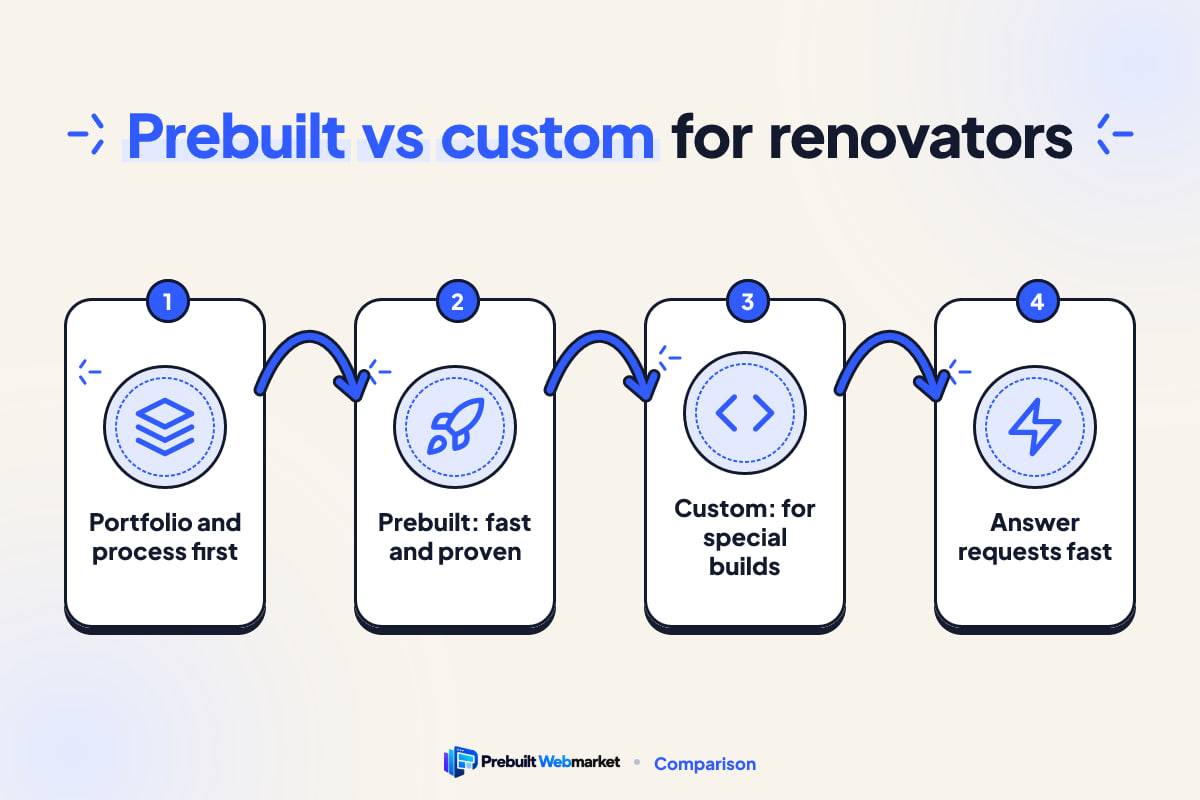
Quick answer
For most renovation companies, a prebuilt renovation website is the better first choice: it launches in about 7 business days, costs from $97 a month plus $297 setup, and you can click through the finished design before paying. A custom agency build wins when your brand is the product, you need unusual tools such as a live estimator or client portal, and you have the budget and months to wait.
Key takeaways
- A renovation website sells a big, slow decision. Portfolio, process, financing and a consultation funnel matter more than whether the layout was drawn from scratch.
- Prebuilt is faster and cheaper, and you see the real site before you pay. The trade-off is less freedom over structure and a monthly fee that never ends.
- Custom is the right call for design-led firms, multi-location builders and anyone who needs custom software such as estimators or client portals.
- DIY builders suit a new one-person outfit with more evenings than budget, as long as someone keeps the portfolio current.
- Neither route fixes slow follow-up. Answer consultation requests within minutes, whichever site you choose.
- Compare three-year cost, not launch price, and ask every provider who owns the domain, content and leads if you leave.
In this article
- The short answer: which option fits which renovation company?
- What a renovation website has to do that most sites don’t
- Prebuilt renovation website: how it works and where it falls short
- Custom agency renovation website design: what you are paying for
- DIY builders: when doing it yourself makes sense
- How much does a renovation website cost: prebuilt vs custom vs DIY?
- Time to launch and the real cost of waiting
- Does a prebuilt renovation website rank as well as a custom one?
- Lead follow-up: the part neither option fixes by itself
- Flexibility and risk: what happens in year two and beyond
- How do you decide between prebuilt and custom renovation web design?
- How PrebuiltWebMarket helps renovation companies
- Your next step
- Frequently asked questions
A prebuilt renovation website is the better choice for most renovation companies. It launches in about 7 business days instead of months, costs a fraction of a custom agency build, and you can click through the real, finished design before you pay a cent. A custom build is the better choice when your brand is the product, when you need custom software such as a live estimator or client portal, or when you run several locations with their own teams.
This guide compares three routes side by side for owners of general contracting, design-build and home renovation companies: a prebuilt site customised to your brand, a custom build from an agency or freelancer, and a do-it-yourself builder. It covers time to launch, real cost over three years, quality, SEO, flexibility and risk, and it says plainly when you should not buy from us.
The short answer: which option fits which renovation company?
Most renovation companies with one office, a defined service area and a mix of kitchens, bathrooms, basements and additions should start with a prebuilt renovation website. Design-led studios, larger multi-location builders and firms that need custom tools should go custom. New one-person outfits with tight budgets and spare evenings can start with a DIY builder.
The table below summarises the comparison. Each row is covered in detail later in the article.
| Factor | Prebuilt website | Custom agency build | DIY builder |
|---|---|---|---|
| Time to launch | About 7 business days | Commonly 2 to 4 months | Your own evenings, often weeks |
| Upfront cost | $297 setup with us | Typically several thousand dollars or more | Low |
| See it before you pay | Yes, a live working demo | No, mockups and drafts | Yes, but you build it |
| Unique structure and features | Limited to proven layouts | Anything you can pay for | Limited by the builder |
| Who maintains it | Us, edits included | Agency retainer or you | You |
| Biggest risk | Less freedom to change structure | Budget overrun and delays | Slow, dated site nobody updates |
If you are weighing a DIY builder seriously, our honest guide to website builders versus prebuilt sites goes deeper on that choice. The rest of this article focuses on what is specific to renovation work.
What a renovation website has to do that most sites don’t
Before comparing options, it helps to be clear about the job. A plumber’s website mostly needs a phone number and a fast “book now” button. A renovation company’s site has a harder task, and that task should decide which route you take.
Sell a big decision to a stranger
A kitchen remodel, a basement finish or a second-storey addition is one of the largest purchases most households make. Homeowners research for weeks or months, often in the evening on a phone, and they compare several contractors before inviting anyone into their home. Your site has to make a stranger trust you with their house and their savings before you ever meet.
Prove you have done this exact kind of work
The portfolio is the centre of a renovation site. A homeowner planning a basement wants to see basements, ideally in homes like theirs. That means a project gallery that filters by project type, with real photos, a short story for each job (the problem, the plan, the result) and, where you can, the timeline and rough budget band.
Answer “how does this work and when can you start?”
Homeowners worry about disruption, delays and surprise costs. A clear process page that walks through consultation, design, quote, permits, build and handover removes much of that fear. Say how long a typical kitchen takes in your business, what happens if you find rot behind a wall, and how you communicate during the build.
Make financing visible
Many renovation projects are paid for with financing, home equity or staged payments. A financing page that explains the options you actually offer, and who your lending partner is, lets a homeowner see a monthly figure instead of a frightening total. Check with your financing partner before publishing any rates or payment examples, because advertising credit terms comes with rules.
Qualify leads before the site visit
Your time is expensive. A design consultation funnel asks a few smart questions first: project type, rough budget band, timing, address. That lets you prioritise serious enquiries and turn up to the first meeting prepared, instead of driving across town for a $3,000 job you do not want.
These five jobs are the same for nearly every renovation company. That is exactly why a proven layout works well here, and why custom design adds the most value only when you need something beyond them.
Prebuilt renovation website: how it works and where it falls short
A prebuilt renovation website is a complete, working site already designed for renovation companies, customised with your logo, colours, photos, services, service areas and copy. You are not buying a theme to assemble yourself. The pages, layout and lead forms already exist and have been tested; what changes is everything that makes the site yours.
What you get on day one
Our renovation designs come with seven core pages: Home, Services, Portfolio, Process, Financing, About and Contact. They include a project portfolio with filters, a design consultation funnel, process and timeline pages, and a financing options page. Hosting, SSL, daily backups, Google Analytics 4 and lead forms that send to email and SMS are all part of the Launch plan.
You can open each one before deciding. Buildwell Renovations, set in St. Louis, Missouri, leads with fixed-price kitchens, basements and additions. Atelier Northwest, set in Bellevue, Washington, takes an architectural, editorial approach for whole-home design-build. HomeRise Remodeling in Jacksonville, Florida, focuses on additions and outdoor living, and Craft and Timber Builders in Bozeman, Montana, has a mountain craftsman feel.
The honest limits of prebuilt
Prebuilt is not right for everyone, and the trade-offs are real:
- Structure is mostly fixed. You can change colours, fonts, images, copy, pages and service areas, but you are working within a proven layout. If you want a completely different navigation idea or an unusual interactive feature, prebuilt is the wrong tool.
- Another company may use the same design. It will have their name, photos, colours and copy, usually in a different market, but the bones are shared. Most homeowners never notice; a design-led brand might care.
- The fee is ongoing. You pay monthly for as long as you use it. That includes hosting, edits and support, but over many years it adds up, and you should compare it fairly with a one-off build plus hosting.
- Custom software is out of scope. A live estimator tied to your pricing sheet or a client portal with selections and schedules needs a developer.
Who prebuilt suits best
Prebuilt fits a renovation company that wants a premium, proven site live quickly, would rather spend time on jobs than on web projects, and gets most work from a defined local service area. Good examples are a two-crew design-build firm, a general contractor moving from referrals to online leads, or an established remodeler whose current site is slow and out of date.
Custom agency renovation website design: what you are paying for
A custom build starts from a blank page. An agency or freelancer interviews you, plans the structure, designs mockups, builds the site and then revises it until you approve. Done well, the result fits your brand exactly. Done badly, it costs more and takes longer than you planned.
Discovery, design rounds and build
Most custom projects follow a similar path: a discovery phase to understand your business, a sitemap and wireframes, two or three rounds of design mockups, development, content entry, testing and launch. Each stage needs your input and approval. The longest delays usually come from content: project photos, write-ups and service descriptions that the owner has to supply.
You will not see the real working site until late in the project. You approve static images and trust that the finished site will behave as well as it looks.
Where custom earns its price
Custom is the better choice when one or more of these is true:
- Your brand is part of the product. An architect-led design studio or a luxury builder whose clients buy taste and identity may need a site that looks like nobody else’s.
- You need custom tools. An online estimator that prices a bathroom from real inputs, a client portal with schedules, selections and change orders, or deep integration with your project management or accounting software.
- You run several locations or divisions. Separate teams, service areas and brands under one parent company can need a structure a single-company layout does not cover.
- You have an in-house marketing team. If someone on staff will run campaigns, landing pages and tests every week, a custom build they control can make sense.
The risks to manage
The main risks are budget creep, timeline slip and dependence on one person. Ask for a fixed quote that lists every page and feature, a written timeline with dates for your content, and clear terms on who owns the code, the design files and the domain. Ask who will make edits after launch, what they cost and how fast they happen. An agency that is excellent at launch but slow at small updates leaves you with a portfolio that stops growing.
DIY builders: when doing it yourself makes sense
A DIY builder is a hosted tool where you pick a template and edit it in your browser. For a renovation business it can work in one situation: you are just starting, you have more evenings than budget, and you enjoy design and writing.
What DIY does well
DIY is cheap to start, you control every word, and you can change things yourself at midnight. For a new company with five finished projects and no referrals yet, a clean, simple site with a phone number, a short portfolio and a contact form is far better than nothing.
Where DIY struggles for renovation work
The weak points are the things renovation sites depend on most. Large project photo galleries are heavy and often slow down DIY sites on phones. Filterable portfolios, multi-step consultation funnels and proper schema markup take skill to set up. And the biggest problem is time: the portfolio is supposed to grow after every job, and in a busy season it usually does not.
If you go DIY, set one rule: add every finished project to the portfolio within two weeks, with photos and a short story. That habit matters more than the template you choose.
How much does a renovation website cost: prebuilt vs custom vs DIY?
Over three years, a prebuilt renovation website on our Launch plan costs $3,789 in total ($297 setup plus 36 months at $97), or $3,207 if you pay yearly. A custom agency build usually costs several thousand dollars up front plus hosting and maintenance every month. DIY is cheapest in cash but costs the most in your own time. Compare total cost over three years, not launch price.
The table below shows what is usually included in each option’s cost. Agency and DIY figures are described as typical because prices vary widely by provider and region; get written quotes before deciding.
| Cost item | Prebuilt (our Launch plan) | Custom agency build | DIY builder |
|---|---|---|---|
| Design and build | Included in $297 setup | The largest single cost | Your time |
| Hosting, SSL and backups | Included in $97 a month | Usually a separate monthly fee | Included in the plan fee |
| Edits after launch | 3 content edits a month included | Retainer or hourly | Your time |
| Speed and technical SEO | 100/100 on-page SEO and 95+ PageSpeed guaranteed at launch | Depends on the agency | Depends on your skill |
| Contract | Month-to-month | Often a project contract plus retainer | Monthly or yearly plan |
Our plans over three years
The chart below shows the three-year cost of each PrebuiltWebMarket plan on monthly billing, including the one-time $297 setup fee.
- Launch ($297 + $97 x 36)$3,789
- Growth ($297 + $297 x 36)$10,989
- Scale ($297 + $497 x 36)$18,189
Paying yearly costs less: $970, $2,970 or $4,970 a year, plus the same $297 setup fee.
Source: PrebuiltWebMarket pricing, 2026
On yearly billing the Launch plan costs $297 plus $970 a year, which is $3,207 over three years. Growth adds the SEO blog package and Scale adds the GoHighLevel CRM, so their totals include much more than the site itself.
Putting the cost next to one job
For a renovation company, the useful question is how many projects the site has to win to pay for itself. The next chart is a worked example with round numbers you can replace with your own.
- $1,461Launch plan, year 1
- $5,000Bathroom ($25,000 at 20%)
- $12,000Kitchen ($60,000 at 20%)
- $30,000Addition ($150,000 at 20%)
Example only. Your prices and margins will differ. Launch plan year 1 is $297 setup plus $97 x 12.
Source: Illustrative example: assumed project prices at an assumed 20% gross margin
In this example, one bathroom project at a 20% margin covers more than three years of the Launch plan, and one kitchen covers it many times over. The same maths applies to a custom build: the question is not which option is cheapest, but which one starts winning projects soonest and keeps winning them.
Time to launch and the real cost of waiting
Time is the factor owners most often underestimate. A custom build that takes four months is four months of homeowners finding someone else when they search for a remodeler, check your name after a referral or look you up from a yard sign.
Why renovation timelines slip
Renovation sites are content-heavy. The portfolio needs selected photos, captions and project stories; the process page needs your real steps; the services pages need detail on each type of job. In a custom project, design waits on content and development waits on design. In a busy season, the owner’s homework sits for weeks. Our guide to how long a business website takes to build breaks down where the time goes.
How prebuilt shortens it
With a prebuilt site the design, structure and code already exist, so the only work is your content and customisation. We guarantee launch within 7 business days of receiving your content. Start with your best 10 to 15 projects and add more through your monthly edits; you do not need a perfect portfolio on launch day.
Timing it to your season
Many homeowners plan renovations months ahead, and in colder states much exterior work waits for spring. A site that goes live while people are researching gives you a full planning season of enquiries. Our guide to renovation website design in Alaska shows how sharply the sales calendar can differ from the build calendar in one state.
Does a prebuilt renovation website rank as well as a custom one?
Yes, it can. Google ranks pages on speed, clean code, clear structure, useful content and signals such as reviews, not on whether the design is unique. A prebuilt site built on modern, fast code often beats a heavier custom one technically. What decides rankings over time is the content and local signals you add, whichever route you take.
Speed and Core Web Vitals
Core Web Vitals are Google’s measures of how fast a page loads, how quickly it responds and how stable it is while loading. Renovation sites are photo-heavy, which makes speed harder. Every PrebuiltWebMarket site is guaranteed to score 100/100 for on-page SEO and 95+ for PageSpeed performance at launch. With a custom build, ask for those numbers in writing, and test any agency’s past work on your phone. Our article on website speed for local businesses explains what slows sites down.
Project pages, service pages and area pages
The renovation companies that rank well usually have a separate page for each main service (kitchens, bathrooms, basements, additions, whole-home renovations), a page for each area they really serve, and a portfolio entry for each finished project. Each project page can mention the type of work and the neighbourhood, which gives search engines and homeowners more reasons to match you to a search. Our bathroom remodeling website guide for Indiana shows how this works for one specialty.
AEO and GEO for renovation questions
AEO, answer engine optimisation, is structuring content so it can be shown as the direct answer to a question. GEO, generative engine optimisation, is making your business easy for AI assistants such as ChatGPT, Gemini and Google’s AI Overviews to understand and cite. Homeowners ask these tools questions like “how long does a kitchen remodel take?” or “do I need a permit to finish a basement?”
Answer those questions plainly on your site, in your own numbers: “Most kitchen remodels we complete take 6 to 10 weeks from demolition to handover.” Add FAQ and LocalBusiness schema, keep your name, address and phone the same everywhere, and collect reviews that mention the project type. For permits and contractor licensing, explain your process and tell readers to confirm local rules with their city or state licensing board, rather than quoting rules from memory. Our plain-English guide to AEO and GEO covers the basics.
Content keeps paying back
A blog that answers renovation questions, such as costs by project type, how to plan a basement or what happens during a design consultation, gives you pages that bring in homeowners months before they are ready to call. Most owners never find the time to write it. If that is you, our SEO blog package for contractors publishes the articles for you.
Lead follow-up: the part neither option fixes by itself
A beautiful site, custom or prebuilt, still loses jobs if consultation requests sit unanswered. Homeowners often ask two or three contractors for a consultation at once. The first one to reply with a clear next step has a real head start, and the one who replies three days later is often too late.
What good follow-up looks like for a remodeler
A CRM, customer relationship management system, records every enquiry and handles the follow-up you would forget in a busy week. The table below is a simple sequence for a design consultation request.
| When | What happens | Why it matters |
|---|---|---|
| Within 1 minute | Automatic text and email confirming the request, with what happens next | The homeowner knows you are real and responsive |
| Same business day | A call to understand the project and book the consultation | A person builds trust a form cannot |
| Day before the visit | Reminder with your name, arrival time and what to have ready | Fewer no-shows and better first meetings |
| 2 to 3 days after the quote | Check-in to answer questions about price, timing or financing | Big decisions stall without a nudge |
| After handover | Thank you, review request and a portfolio photo session | Reviews and photos feed the next sale |
Missed calls and long sales cycles
You are on a job site with a saw running when the phone rings. A missed-call text-back sends the caller a message straight away, so they wait for you instead of ringing the next remodeler. Pipelines show every lead’s stage, from new enquiry to quote sent to signed, which matters when projects take weeks or months to decide. Only text people who have agreed to receive messages, and follow the rules for business texting.
Our Scale plan includes this setup in GoHighLevel; the GoHighLevel CRM package page lists everything it covers.
Flexibility and risk: what happens in year two and beyond
Launch day is the easy part. The real test of any option is what happens 18 months later, when you want to add a new service, update the portfolio after a busy season or change your financing partner.
Making changes
With a prebuilt plan, changes come through monthly content edits: 3 a month on Launch, 10 on Growth and unlimited on Scale. With a custom build, changes depend on your agency’s retainer or hourly rate and their workload. With DIY, every change is yours to make. Pick the route where the portfolio will actually keep growing, because a portfolio that stops in 2025 tells homeowners something.
Ownership and leaving
Ask every provider three questions in writing: who owns the domain, who owns the content and design files, and what you can take with you if you leave. With PrebuiltWebMarket your domain is registered in your name, and your content, leads and CRM data are yours. Plans are month-to-month, so you are never locked in by a contract. With a custom build you may own the code outright, which is a genuine advantage if your contract says so.
The single-person risk
Many contractors have been left with a site nobody can update because the freelancer who built it moved on, or the nephew who set it up went to college. Whatever you choose, make sure your domain login is in your name, your hosting is documented, and more than one person can make changes.
How do you decide between prebuilt and custom renovation web design?
Decide by your needs, not by price alone. If a proven renovation layout covers what you sell and you want to be live this month, choose prebuilt. If you need custom software, a one-of-a-kind brand or a multi-location structure, choose custom. If you are brand new with no budget, start DIY and plan to move up.
The table below turns that into a quick checklist. Find the rows that describe your business.
| If this is true for your business | Lean towards | Why |
|---|---|---|
| You want to be live within two weeks | Prebuilt | Design and code already exist |
| You need an online estimator or client portal | Custom | Requires custom development |
| Your brand look is what clients are buying | Custom | You need a design nobody else has |
| You run one office with a defined service area | Prebuilt | Proven layouts cover this well |
| You have under $1,000 and spare evenings | DIY | Cheapest way to get started |
| You want edits, hosting and speed handled for you | Prebuilt | Included in the monthly plan |
| You have an in-house marketer running weekly tests | Custom | They need full control |
Five questions to ask before you sign anything
- Can I see a live, working site you built, on my phone, before I pay?
- What is the total cost over three years, including hosting and edits?
- What are the PageSpeed and on-page SEO scores at launch, in writing?
- How fast are edits made, and how many are included?
- Who owns the domain, content and leads, and what happens if I leave?
For a broader side-by-side covering WordPress, GoHighLevel’s builder, freelancers and agencies, see our page that compares every website option, or the general guide to prebuilt versus custom websites for all industries.
How PrebuiltWebMarket helps renovation companies
We build renovation sites from designs that already exist and already work, so you can judge the real result before you commit. There are 4 renovation designs among more than 100 live demos across 29 industries, and you can browse every industry’s designs if you also run a related trade.
Here is what happens when you choose one:
- You pick a design from the renovation website demos and book a free call.
- We customise it with your logo, colours, projects, services, process, financing partner and service areas.
- We launch it within 7 business days of receiving your content, on your own domain.
- We look after it. Hosting, SSL, daily backups and your monthly edits are included.
Every site is guaranteed to score 100/100 for on-page SEO and 95+ for PageSpeed performance at launch. If you are not happy in the first 30 days, we refund your first month. There is no contract, and you keep your domain, content and leads. We do not promise rankings or a set number of leads, because nobody honestly can.
If you need an estimator, a client portal or a one-of-a-kind brand, we will tell you on the call that a custom build is the better route. That is a better outcome for you than a site that does not fit.
Your next step
If your current site is slow, has a portfolio that stopped growing years ago, or you have been putting off a custom build because of the cost and the months it would take, a prebuilt site is worth a serious look.
Start by clicking through Buildwell Renovations in St. Louis and the other renovation demos on your phone, as a homeowner would. Then book a free consultation call to talk through your projects and the plan that fits. If you would rather ask a question in writing first, use our contact form.
Frequently asked questions
Is a prebuilt renovation website good enough for a high-end remodeler?
Often, yes. What sells high-end work is the quality of your photos, project write-ups and process, not whether the layout was drawn from a blank page. Choose a premium design, use professional photography and write real project stories. If your brand identity is the main thing clients are buying, as with an architect-led design studio, a custom build is worth considering.
How much does a custom renovation website cost compared with prebuilt?
Custom agency builds for contractors typically run into several thousand dollars up front, often more, plus hosting and maintenance. Prices vary widely, so get written quotes. A prebuilt renovation website from PrebuiltWebMarket costs $297 setup and $97 a month on the Launch plan, which is $1,461 in the first year with hosting, SSL and 3 edits a month included.
How long does each option take to launch?
A prebuilt renovation website from PrebuiltWebMarket launches within 7 business days of us receiving your content. A custom agency build commonly takes two to four months once discovery, design rounds, development and revisions are counted. A DIY builder depends entirely on your own evenings and weekends, and the portfolio is usually the part that drags on.
Will a prebuilt website rank as well as a custom one on Google?
Rankings depend on speed, clean code, page structure, content and reviews, not on whether a design is unique. A well-built prebuilt site can match or beat a custom one technically. We guarantee 100/100 on-page SEO and 95+ PageSpeed performance at launch, but nobody can honestly guarantee a ranking position.
Can I add project galleries and financing pages to a prebuilt renovation website?
Yes. Our renovation designs already include a filterable project portfolio, process and timeline pages, a financing page and a design consultation funnel. We load your projects, services, service areas and financing partner details during setup, and you can request changes through your monthly content edits.
Do I own my website if I choose a prebuilt plan?
With PrebuiltWebMarket your domain is registered in your name, and your content, leads and CRM data belong to you. Plans are month-to-month with no contract. Whichever provider you use, ask in writing who owns the domain, the content and the design files, and what you can take with you if you leave.
When should a renovation company choose custom web design?
Choose custom when you need something no proven layout covers: an online estimator tied to your pricing, a client portal with schedules and selections, integration with your project management software, or a brand-led design that is itself part of what you sell. You also need the budget and patience for a two- to four-month build.
Is it worth building my renovation website myself?
It can be if you are just starting, have little budget and enjoy the work. Expect to spend many evenings on layout, writing and photo editing, and to handle speed, SEO and updates yourself. Many owners start DIY and move later when the site needs to win larger projects and they no longer have the time to maintain it.
What matters more than the website when winning renovation jobs?
Speed and quality of follow-up. A homeowner who requests a consultation from three contractors often goes with whoever responds first with a clear next step. A fast automatic reply, a call within business hours and reminders before the site visit can matter as much as the design itself.