
Quick answer
An hourly removalist rate on its own under-states the bill, because call-out or travel time, minimum hours, billing increments and extras are added on top. Show the full formula on your website, beside a worked example such as a two-bedroom unit, give estimates as a range, and repeat the same formula in the booking confirmation so the invoice matches what the customer expected.
Key takeaways
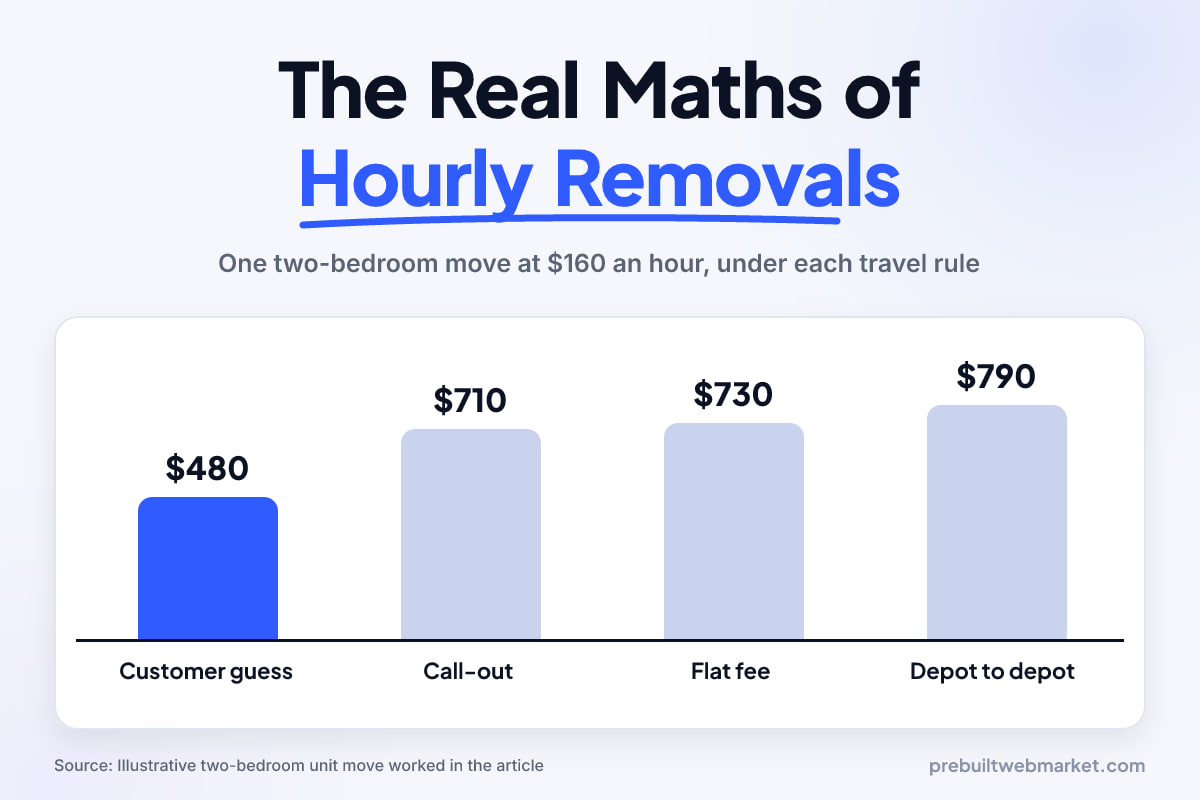
- Customers multiply your hourly rate by their own guess at the hours. In the illustrative example that guess is $230 short of the real invoice.
- Call-out or travel time is usually the biggest gap between the advertised rate and the bill. Say exactly how you charge it.
- Billing increments matter: at a $160 rate, rounding up to the next 15 minutes can add up to $40 to an invoice, and rounding to the next hour up to $160.
- Whether the customer is fully packed changes the total more than crew size does. Say what happens if they are not.
- Publish one worked example and an estimate range, as plain text, not a single figure or an image of a rate card.
- Redo the sums with your own last 20 invoices before you change a single word on the pricing page.
In this article
- The question the numbers answer
- The inputs, and where to find your own
- A two-bedroom unit move, worked step by step
- The same move under three travel methods
- What changes the answer most
- Showing removalist website hourly rates on the page
- What to leave off the pricing page
- The booking confirmation that closes the gap
- What the numbers do not capture
- Your own calculation, as a checklist
- Your next step
- Frequently asked questions
Removalist website hourly rates only make sense to a customer when the whole sum is on the page: the rate for the crew, the minimum, how call-out or travel time is charged, how time is rounded and what costs extra. Show the rate alone and the customer fills in the rest with a guess, and the guess is almost always low.
That gap matters more for removalists than for most trades. The customer books weeks ahead, pays on the day, and is standing in a half-empty unit when the invoice arrives. If the number is $200 more than they expected, it does not matter that every line was fair: the review says “hidden fees”. This article works through one illustrative two-bedroom unit move, line by line, so you can see exactly where the extra comes from and how to put the maths on your removalists website before the truck is booked.
The question the numbers answer
The question is simple: how far is the number a customer works out from your website from the number on your final invoice? Every other pricing decision, from the call-out fee to the wording of the rate card, is a way of closing that gap.
The guess the customer makes
A customer moving out of a two-bedroom unit sees “$160 an hour, two removalists and a truck”. They think the job will take about three hours, because that sounds right for two bedrooms, and they budget $480. They have no idea how long a second-floor walk-up takes to empty, that the clock includes travel, or that time is billed in blocks. They are not being careless; your rate is the only number you gave them.
The number you actually invoice
Your invoice is built from more parts than that. There is time on site, time on the road between addresses, a call-out or travel charge, rounding to your billing increment, materials such as mattress covers, and sometimes a weekend loading. Each part is reasonable. Added together, they can make the bill half as much again as the customer’s guess, which is exactly what happens in the worked example below.
The inputs, and where to find your own
The inputs to an hourly removals price are the crew rate, the minimum, the call-out or travel method, the billing increment, extras, and the real time your jobs take. You already hold every one of them in your invoices, timesheets and truck logs; most owners just have never laid them side by side.
Crew and truck rate
This is the headline figure: the price per hour for a set crew size and truck. Most removalists quote two or three rates, such as two removalists and a truck, or three removalists and a larger truck. Our illustrative business charges $160 an hour for two removalists and $210 an hour for three, both including GST. Check what you actually charged on your last 20 invoices; discounts and “mates rates” often pull the real average lower than the rate card.
The minimum
A minimum charge protects you from a 40-minute job that ties up a crew for half a day. Our example uses a 2-hour minimum. Look at how many of your jobs finish under the minimum: if it is one in ten, the minimum is doing its job; if it is one in three, you have a small-jobs market that might deserve its own price.
Call-out and travel time
This is the input customers understand least and the one that moves the total most. There are three common methods: a fixed amount of call-out time added to every job (our example adds 30 minutes at the hourly rate), a flat travel fee, or running the clock from the moment the truck leaves the depot until it returns. Your truck’s GPS log or the crew’s start and finish times on the timesheet will tell you how much unpaid road time you are actually carrying.
Billing increment
After the minimum, time has to be rounded to something: the minute, the next 15 minutes, the next half hour or the next hour. Our example rounds up to the next 15 minutes. Find this on your invoice template; if nobody has ever written it down, your crews are probably rounding differently from one another.
Extras
Extras are anything charged outside the clock: mattress covers, boxes, a piano or pool table, a second truck, or a weekend or public holiday loading. Our example uses two mattress covers at $15 each and a Saturday loading of $20 an hour. Your accounting software will show which extras appear on more than one invoice in five; those are the ones the website must mention.
What your jobs really take
The last input matters most: the real on-site time for each kind of move. Pull the timesheets for your last 20 jobs of each size and note the on-site time, the access at both ends and whether the customer was packed. Queensland highsets and inner-city walk-ups can add a lot of loading time, which is why our Queensland removalist website guide puts access questions at the top of the quote form.
A two-bedroom unit move, worked step by step
The worked example shows the bill growing from a $480 guess to a $710 invoice in four honest steps. The job is a fictional one: a two-bedroom unit on the second floor of a walk-up block, moving to a three-bedroom house about 12 kilometres away. The customer has packed 35 boxes. The furniture is a queen bed, a double bed, a three-seater couch, a fridge, a washing machine, a dining table with six chairs and two bookcases.
Step 1: time on site
The crew arrives at 8:00 am, walks through the unit with the customer and lays floor protection, which takes 10 minutes. Loading down two flights of stairs takes until 10:00 am. The drive to the new house runs from 10:00 to 10:30 am. Unloading into the house, at ground level with a short carry, and reassembling both beds runs until 11:40 am. Paperwork and payment take 5 minutes.
From arrival to finish, that is 3 hours and 45 minutes on the clock. Notice that the drive between the two addresses is inside that time. Customers often assume it is not, and it is worth saying on the website that it is.
Step 2: add call-out time
Our example adds a fixed 30 minutes of call-out time to every job, to cover getting the truck to the first address and back from the last. That takes the billed time to 4 hours and 15 minutes.
Step 3: round to the increment
The total already lands on a quarter hour, so 15-minute rounding changes nothing here. At the hourly rate, 4.25 hours × $160 = $680.
Step 4: extras and the total
Two mattress covers at $15 each add $30. The invoice is $710, including GST.
The customer budgeted $480. The difference is $230, or about 48% more than they expected. Every minute was worked. The customer simply did not have the information to do the sum, and that is a website problem, not a crew problem.
The same move under three travel methods
The travel method alone moves the same job by $80, from $710 to $790, which is why it must be spelled out next to the rate. Here is the identical move costed three ways, with every other input unchanged.
Fixed call-out time
As above: 3 hours 45 minutes on site, plus 30 minutes of call-out, gives 4.25 hours × $160 = $680, plus $30 of materials, for $710. This method is the easiest for a customer to predict, because the travel part is the same on every job.
Depot to depot
Now assume the clock runs from the depot. The truck leaves at 7:35 am, 25 minutes before arriving, and gets back at 12:20 pm, 35 minutes after finishing. That is 4 hours 45 minutes, so 4.75 hours × $160 = $760, plus $30, for $790. It is fair to you across a wide area, but the customer cannot predict it without knowing where your depot is.
Flat travel fee
Finally, assume a flat $100 travel fee and no call-out time. On-site time is 3.75 hours × $160 = $600, plus $100 travel and $30 materials, for $730. A flat fee is predictable, but it loses money on the far edges of your service area unless outer suburbs pay more.
No method is the right one. The point is that the same move costs $710, $730 or $790 depending on a rule most customers never read, so put yours in one plain sentence next to the rate and use it on every job.
What changes the answer most
In the worked example, whether the customer is packed changes the total most, followed by the day of the week, the travel method and the billing increment, while crew size barely changes it at all. Your ranking will differ; find it by changing one input at a time.
Whether the customer is packed
Say the customer has not packed the kitchen. The crew packs it, which adds 45 minutes and about a dozen boxes. At $160 an hour, that is 0.75 × $160 = $120, before the boxes themselves. One unpacked kitchen costs more than any other change in this example, and it is the change customers cause without realising. Your website should say in one sentence what happens if things are not packed when the crew arrives, and the quote form should ask.
Access at both ends
Access works the same way. If the truck cannot park near the building and has to stand 40 metres down the street, our illustrative crew adds about 15 minutes at each end, so 30 minutes, or $80. A booked goods lift in a tower can save time; a lift that someone else is using can lose it. This is why a good quote form asks about stairs, lifts, parking and long carries at both addresses, a point covered in our guide to costly removalists website mistakes.
Day and date
A Saturday loading of $20 an hour on 4.25 billed hours adds $85, taking the invoice to $795. If you charge more on end-of-month or end-of-lease dates, list those dates on the rate card.
Crew size
Crew size barely matters in this example. Assume, for illustration, that a third removalist cuts the on-site time from 3 hours 45 minutes to 2 hours 45 minutes. Add 30 minutes of call-out and the billed time is 3.25 hours × $210 = $682.50, plus $30, for $712.50. That is $2.50 more than the two-person crew, and the customer is moved in an hour less.
On jobs with a lot of stairs a third person can save more than that, making the bigger crew cheaper, which is worth telling customers who assume three removalists always cost more.
Rounding
At $160 an hour, rounding up to the next 15 minutes adds up to $40 to an invoice; rounding to the next half hour adds up to $80; rounding to the next hour adds up to $160. If a job finishes at 3 hours 40 minutes on site, the customer pays for 3 hours 45 minutes, 4 hours or 4 hours depending on your rule. Customers rarely object to rounding they were told about, only to rounding they find on the invoice.
Showing removalist website hourly rates on the page
The right way to show removalist website hourly rates is a short rate card written as text, one worked example for a common move, an estimate range and a sentence for each rule that changes the total. The aim is that a customer who reads the page could do your sum themselves and land within about 10% of the invoice.
The rate line
Each crew size gets one line that carries the whole formula, not just the price. For our illustrative business it reads:
- Two removalists and a truck: $160 an hour, including GST.
- Three removalists and a larger truck: $210 an hour, including GST.
- 2-hour minimum, plus 30 minutes call-out on every job.
- The clock starts when we arrive and stops when we finish unloading; the drive between addresses is included.
- After the minimum, time is billed in 15-minute blocks.
- Saturdays: $20 an hour extra. Mattress covers $15 each. Everything else is on the clock.
Our Little Wombat Movers demo, set in Melbourne, shows how an hourly removalist can lay out this kind of rate information alongside interstate backloading by the cubic metre, without the page turning into a contract.
The worked example on the page
Under the rate card, show one complete example in plain sentences: the move, the times, the calculation and the total. A two-bedroom unit is a good choice for most metro removalists because it is the move people most often ask about. Say clearly that it is an example and that their move may take more or less time.
It also quietly answers “is this removalist going to surprise me?” before anyone has to ask on the phone.
An estimator that gives a range
If you add a calculator to a website for removalist bookings, have it return a range, not a single figure. A customer picks the number of bedrooms, the floors without a lift at each end and whether everything will be packed, and the result says something like “Most moves like this take 3.5 to 4.5 hours, so expect about $640 to $800 including call-out”.
Build it with ordinary form controls. MDN’s documentation on the HTML output element notes that many browsers expose it as a live region, so screen readers announce the new estimate without the user losing their place in the form. MDN’s guidance on number inputs explains how min, max and step constrain a value such as flights of stairs, and also says the number type is not appropriate for values like postcodes, which should be a text field with a numeric keyboard instead.
Rate cards as text, not images
Many removalists post their rate card as a designed image or a PDF flyer. That looks tidy, but a customer zooming in on a phone struggles to read it, search engines cannot reliably read the prices, and some customers cannot read it at all. The W3C’s explanation of WCAG non-text content sets out why information in an image needs a text alternative, and for a price list the simplest alternative is to write the prices as text in the first place.
The structure matters too. The W3C’s guidance on info and relationships explains that when items are arranged in rows and columns, the relationship between each cell and its header needs to be in the code, not only in the visual layout. If your rate card compares crew sizes, build it as a real list or table with headers, so “$210” is clearly tied to “three removalists”.
Marking up the rate for search engines
Hourly prices can also be described in structured data. Schema.org’s UnitPriceSpecification type lets a price be tied to a unit of measure with unitCode, state whether tax is included with valueAddedTaxIncluded, and use billingIncrement to give the minimal quantity and rounding increment that billing is based on, which is exactly your 15-minute block. Structured data does not guarantee any display in search results, but it keeps the facts about your rates consistent for search engines and AI assistants that read the page.
What to leave off the pricing page
Leave off anything that makes the total harder to work out: “from” prices you rarely charge, rate cards with no minimum or call-out stated, and claims you cannot keep on moving day.
- “From $99 an hour” when nobody pays it. If the lowest rate only applies to a weekday one-person job you almost never run, the customer will anchor to it anyway. Lead with the rate most customers will pay.
- “No hidden fees” above a page that lists none of the fees. The claim only works when every fee is visible right underneath it.
- A single “average move” price. Averages hide the range. A range for a two-bedroom move is honest; “average move $650” reads as a quote.
- Different rules on different pages. If the interstate page says the clock starts at the depot and the local page says it starts on arrival, customers will assume the more expensive one applies to them. One rule, written once, linked from everywhere.
If you also offer fixed-price moves, explain when you use each. Our field guide to binding and non-binding estimates was written for American movers, but its approach to defining each estimate type in a sentence applies just as well to an Australian business that offers both hourly and fixed prices.
The booking confirmation that closes the gap
The booking confirmation is where the website maths becomes a promise, so it should repeat the same formula, in the same words, with the customer’s own details filled in. A customer who reads “2 removalists at $160 an hour, 2-hour minimum, plus 30 minutes call-out, billed in 15-minute blocks” on the website, the confirmation email and the invoice has no reason to feel ambushed.
What the confirmation should say
The confirmation should list the crew size and rate, the date and arrival window, the minimum and call-out, the billing increment, any extras already agreed, and the estimate range from the quote. Add the one sentence about what happens if things are not packed, and a reminder to book the goods lift or loading zone if either building needs it.
The day-before message
A short message the day before, by email or SMS, is the cheapest dispute prevention you can buy. It repeats the arrival window and the formula and asks the customer to reply if anything has changed, such as extra furniture or a different address. If you want these messages sent automatically from each website booking, a CRM can handle it, which is what our GoHighLevel CRM setup does on the Scale plan.
What the numbers do not capture
The numbers do not capture everything that makes an hourly job worth taking: your own costs, the risk on the day, the value of a good review and the jobs that should never be hourly in the first place.
Your cost per crew hour
The customer’s maths is only half the picture. The other half is what each crew hour costs you in wages, super, workers compensation, insurance, fuel, truck finance and maintenance. Take those costs from your own payroll and accounts for the last quarter, divide by the hours your crews were actually billing, and you have your break-even rate. Unpaid road time between jobs is the usual reason that figure is higher than owners expect, and it is the honest case for a call-out fee.
A surprised customer also costs more than the disputed amount: a discount asked for on the spot, or a one-star review. None of that shows in the hourly maths, and all of it shrinks with a pricing page that sets the right expectation.
The jobs that should not be hourly
Some jobs suit a fixed price better: interstate moves, large office relocations, jobs with very difficult access and customers who simply need certainty. Hourly pricing rewards the customer who is organised and penalises the one who is not, which is fair for a local house move but uncomfortable for a pensioner downsizing with family help. The Harbour City Removals demo, set in Sydney, shows the alternative approach, leading with fixed-price house, office and interstate moves. Many removalists offer both, and the website should say which jobs get which. The same decision appears in other trades too; our comparison of bedroom versus hourly cleaning prices is a useful outside view.
Your own calculation, as a checklist
Your own calculation takes about an hour with your last 20 invoices open. Work through these steps in order and you will have the numbers your removalists website needs.
- List your rates by crew size, as charged on recent invoices, and note whether they include GST.
- Write down your minimum and how many recent jobs finished under it.
- Choose one travel method: fixed call-out time, flat travel fee or depot to depot. Write it as one sentence.
- Write down your billing increment and confirm every crew rounds the same way.
- List the extras that appear on more than one invoice in five, with their prices.
- Pull on-site times for your most common move, usually a two-bedroom unit or a three-bedroom house, and take the middle half of the jobs as your range.
- Cost one worked example from start to finish, exactly as this article does, and check it against a real invoice.
- Change one input at a time, packing, access, day, crew size, rounding, and note which ones move the total most. Those are the questions your quote form must ask.
- Compare the website guess to the invoice on ten real jobs. Aim to get the average gap under about 10%.
- Rewrite the rate card, the worked example and the confirmation so all three use the same words.
If the checklist shows your current site cannot hold a clear rate card and an estimator, that is a website build question, not a pricing one. Our removalists website designs were built for exactly this: hourly and fixed-price layouts, an interstate quote form and suburb pages, written in Australian English. They run on the Launch plan at $97 a month plus a $297 setup fee, month-to-month, and every plan is laid out on our plans and pricing page. If you are weighing a prebuilt site against a freelancer, an agency or a DIY builder, the comparison of website options sets out where each one fits.
Your next step
Open your last ten invoices for two-bedroom moves this week and do the sum a customer would do from your current website. If the gap is large, fix the rate line first, then add one worked example, then make the confirmation match. If you would like a second opinion on your pricing page or want to see how a removalist site lays this out, book a free 45-minute call and we will go through it with you.
Sources
Frequently asked questions
Should a removalist website show hourly rates?
Yes, if you price local moves by the hour. Show the rate for each crew size, the minimum, how call-out or travel time is charged, the billing increment and what costs extra. A rate on its own invites the customer to guess the total, so pair it with a worked example and a range for common move sizes.
What is a call-out fee for removalists?
It is a charge that covers the crew and truck getting to the first address and back from the last one. Some removalists charge a fixed amount of time, such as 30 minutes or an hour at the hourly rate, some charge a flat travel fee, and some run the clock from depot to depot. Whichever you use, describe it in one sentence beside the rate.
Is depot-to-depot charging fair to customers?
It can be, as long as it is stated clearly before booking and your depot location makes it reasonable. It is harder for customers to predict, because they do not know your drive times. If you charge depot to depot, give typical travel times for the suburbs you serve, or offer a capped travel charge so the customer has a number to plan around.
How do I estimate how many hours a two-bedroom move will take?
Use your own records, not a rule of thumb. Pull the timesheets for your last 20 two-bedroom jobs and note the on-site time, the access at each end and whether the customer was packed. The middle half of those jobs gives you an honest range to publish, and the outliers tell you which questions your quote form must ask.
Should I charge for stairs separately or let the clock cover it?
Either works if it is stated. Letting the clock cover stairs is simpler and fair, because stairs show up as extra time. A per-flight surcharge suits fixed-price jobs where there is no clock. Do not do both on the same job, and make sure your quote form asks about stairs and lifts at each address.
Should my hourly rates include GST?
Show the price a household will actually pay, and say plainly whether it includes GST. Most residential customers compare the number they see against other quotes, so a rate that later grows by the GST amount feels like a hidden fee. Check the ACCC guidance on displaying prices before you publish your rate card.
Will a pricing calculator on my removalists website scare customers off?
A calculator that shows an honest range tends to filter rather than scare. People who need a cheap single figure leave, and the customers who stay arrive with realistic expectations. Label the result as an estimate, show the assumptions under it, and offer a firm quote after a quick call or video walkthrough.