
Quick answer
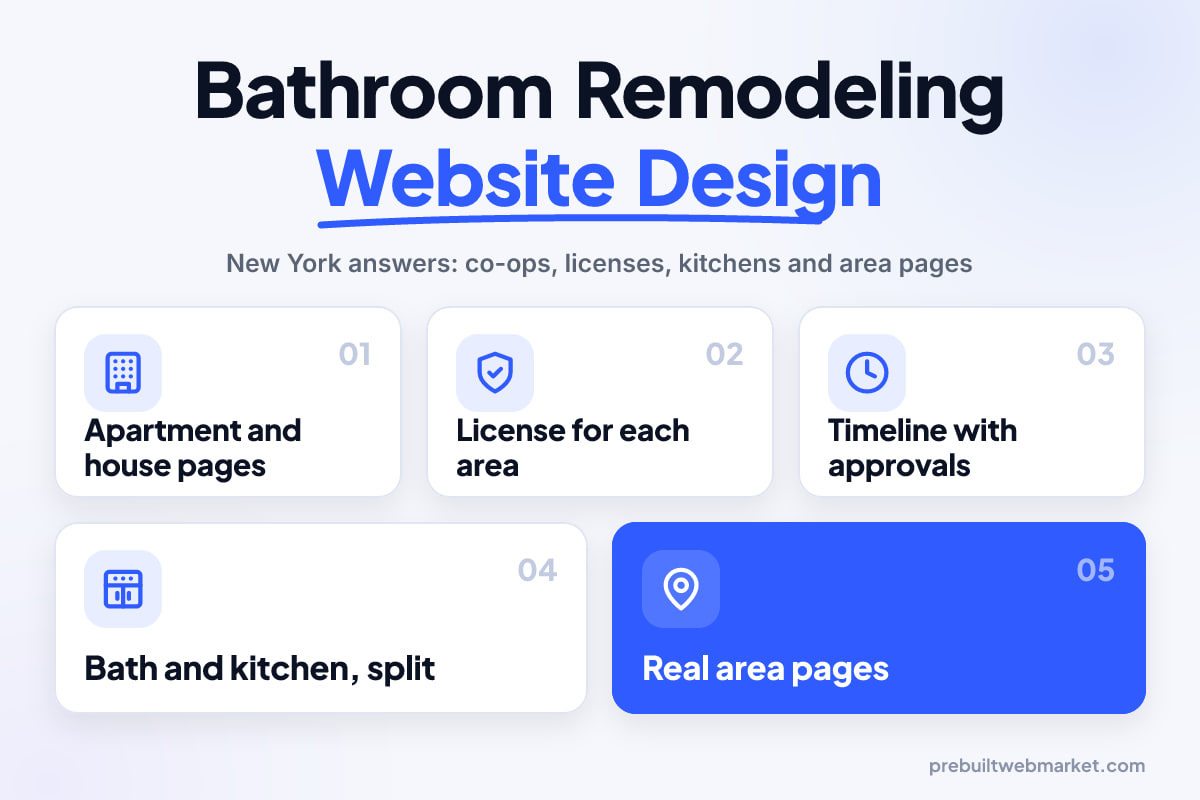
Bathroom remodeling website design in New York has to serve two buyers: apartment owners whose building controls the job, and homeowners in Westchester, Long Island and upstate. Give each its own pages, show the license that applies where you work, explain how board approvals and permits shape the timeline, show price ranges, and build area pages only for places you genuinely serve.
Key takeaways
- Split apartment and house work. A co-op owner in Manhattan and a homeowner in Yonkers ask different first questions, so give each a page that answers them.
- Show the license number that applies where you work, such as the New York City home improvement contractor license or the county license in Westchester, Nassau or Suffolk.
- Explain the timeline in stages: board or permit approval, ordering, demolition, rough-in, inspection and finish. Approvals, not tiling, are what New York buyers worry about.
- One website can sell bathrooms and kitchens if each has its own service page, gallery filter and consult form option.
- Area pages for Yonkers, Westchester and Long Island must describe real housing, real jobs and real rules, not the same text with a new town name.
- Keep a building-paperwork checklist on the site. It answers the question many competitors never address.
In this article
- What does bathroom remodeling website design need to do in New York?
- Should apartment bathrooms and house bathrooms get separate pages?
- How do I show co-op and condo board experience on a website?
- What should my website say about licenses and insurance?
- How do I show prices when approvals change the timeline?
- Can one website sell both bathroom and kitchen remodeling?
- How do I build area pages for Yonkers, Westchester and Long Island?
- What should the consult form ask a New York homeowner?
- Which photos and proof matter most to New York buyers?
- How fast should I reply, and what happens after the form?
- The questions remodelers should ask but rarely do
- What to do next
- Frequently asked questions
Bathroom remodeling website design in New York works when the site answers two different buyers: the apartment owner whose co-op or condo building controls when and how the job happens, and the homeowner in Yonkers, Westchester, Long Island or upstate who is weighing up an older house. Give each buyer their own pages, show the license that applies where you work, explain how approvals shape the timeline, and make the free consult easy to book on a phone.
New York is not one market for a remodeler, and most bathroom remodel websites are written as if it were. The same company can spend Monday on a 1960s co-op bathroom in Queens, where the elevator has to be booked, and Thursday on a 1920s house in Yonkers with cast-iron drains. This article answers, one at a time, the questions New York remodeling owners ask about their website, and links out to deeper guides where a single page needs more detail.
What does bathroom remodeling website design need to do in New York?
Bathroom remodeling website design in New York needs to do three jobs: prove you can work inside the rules that govern the buyer’s building, show finished work that looks like the buyer’s own bathroom, and turn a nervous reader into a booked consult. Pretty photos alone do not do any of the three.
A bathroom remodel is a large spend for any household, and in New York the buyer is often also worried about neighbors, building staff and approvals. That changes the order of what they look for. A homeowner in Ohio might scroll straight to the gallery. A co-op owner on the Upper West Side often looks first for words like “alteration agreement” or “board package”, because the building’s managing agent has already told them what to expect.
So the website has to front-load reassurance, which is what good bathroom remodeling website demos do in their first screen. Your home page should say plainly which kinds of homes you work in, which areas you cover, and what licenses you hold, before it starts talking about tile.
The three questions every visitor brings
Almost every New York bathroom enquiry starts with the same three silent questions:
- Do you work in buildings like mine? Apartment, two-family, brownstone, ranch, colonial.
- Are you licensed and insured for where I live? The answer differs between the five boroughs and the surrounding counties.
- How long will I be without a bathroom? In an apartment with one bathroom, this is the question that decides the job.
If your website answers those three in the first screen and a half on a phone, the rest of the site can do its normal work. If it does not, the visitor goes back to the search results and opens the next tab.
Should apartment bathrooms and house bathrooms get separate pages?
Yes. Apartment bathrooms and house bathrooms should get separate pages, because the buyers ask different questions, worry about different risks and search with different words. One combined “Bathroom Remodeling” page ends up answering neither well.
An apartment page should talk about building approval, work hours, protecting common areas, keeping noise and dust away from neighbors, and fitting a new layout into a fixed footprint. Many buildings will not allow a bathroom to move over a neighbor’s living space, a restriction often called the “wet over dry” rule, so layout changes are limited. Say that you check the building’s rules before you design, not after.
A house page should talk about what you find when you open the walls: old galvanized or cast-iron pipes, uneven floors, small windows, an attic or basement bathroom, and in older homes, lead paint. Homeowners here are more likely to want an extra bathroom, a primary suite or a tub-to-shower conversion for a parent.
What goes on the apartment bathroom page
Keep the apartment page practical. Cover:
- The approval stage, written as a step in your process, with what you prepare and what the owner or their architect prepares.
- Insurance certificates naming the building and managing agent, if that is something you routinely supply.
- Work hours and building staff, and how you schedule deliveries and debris removal around them.
- Protection of hallways and elevators, with a photo of how you actually do it.
- Typical layouts you have remodeled: the windowless bathroom, the narrow tub alcove, the powder room that becomes a shower room.
Finish the page with apartment projects in your gallery, filtered so the visitor sees only apartment work. Our guide to building portfolio filters shows how to set those filters up.
What goes on the house bathroom page
The house page can lean on range. Show a primary bathroom, a hall bathroom, a basement or attic bathroom and a tub-to-shower conversion, each with a short note on what the job involved. If you do accessibility work, link to a separate page for it. Our article on aging in place bathroom pages follows one family through that search and shows what the page must answer.
How do I show co-op and condo board experience on a website?
Show co-op and condo board experience by describing the approval process as a normal, managed stage of your work, with the documents you prepare and the order things happen in. Claims like “board-approved contractor” mean little; a clear process means a lot.
Many co-op and condo buildings in New York City ask for some combination of an alteration application or agreement, drawings, insurance certificates and a schedule before work starts, and each building sets its own rules. You cannot promise how long a board will take. You can explain what you do to keep your part of it moving.
A simple way to present this is a numbered “How a co-op bathroom remodel works with us” block:
- Consult and measure. We see the bathroom and the building’s alteration rules.
- Design and drawings. We prepare the layout and specifications the building asks for, or work with your architect.
- Contractor paperwork. We supply our license details and insurance certificates in the form the managing agent requests.
- Building review. The board or its engineer reviews the package. This is the stage we cannot control.
- Ordering. We order materials once approval is close, so nothing sits in your apartment.
- Work, inspection and sign-off. We work within the building’s hours and keep common areas protected.
Proof that works better than a badge
The strongest proof is specific. A short paragraph on a project page saying “This building required work between 9 and 5 on weekdays only, and no wet work over the unit below” shows experience in a way no logo can. If you have worked in many buildings in one neighborhood, say so in plain numbers that you can stand behind, and do not name buildings or residents without permission.
What should my website say about licenses and insurance?
Your website should show each home improvement license you hold, the area each one covers, and your insurance, in one place that every page links to. In New York this is not a formality, because licensing is handled locally and buyers in different places look for different credentials.
New York does not have one statewide license for general home improvement work. Instead, the city and several counties license home improvement contractors themselves. Get the details from each office before you describe them, and keep the wording on your site short and factual.
New York City
In the five boroughs, the city’s Home Improvement Contractor license from the Department of Consumer and Worker Protection covers construction, repair, remodeling and similar work on residential property. If you work in the city, put your license number in the footer and on your Licensing and Insurance page. Some jobs also involve Department of Buildings filings, which are a separate matter; describe those only in the way your own jobs actually handle them.
Westchester and Yonkers
North of the city, the Westchester County Department of Consumer Protection licenses home improvement contractors and keeps a list the public can search, and its guidance says the license number should appear in your advertising, contracts and proposals. A website is advertising. If you want to rank for searches like “website design for contractor Yonkers” and win the work behind them, a visible county license number is one of the first things a Yonkers homeowner will look for. Check with the City of Yonkers for any permit rules that apply to your type of work.
Long Island
On Long Island, the Nassau County Office of Consumer Affairs licenses home improvement contractors, and Suffolk County’s consumer affairs department runs its own licensing. If you work across both counties, list both licenses and say which county each covers, so a Suffolk homeowner does not have to guess whether your Nassau number applies to them.
Older homes and lead-safe work
Pre-war apartments and many older houses across New York were built long before 1978. Under the EPA’s Renovation, Repair and Painting Program, firms paid to disturb paint in pre-1978 homes must be certified and follow lead-safe work practices. Demolishing a bathroom in a pre-war apartment or an old Yonkers house usually qualifies. If your firm is certified, say so on the house page and the Licensing page, and explain in one sentence what that means for the family: dust is contained and cleaned up properly.
The contract page
The New York State Attorney General’s home improvement fact sheet explains that home improvement contracts must be written, in plain English, and give the customer a right to cancel within three business days of signing. You do not need to restate the law. A short “What you sign with us” section that says you provide a written contract with a clear scope, payment schedule and cancellation notice tells a careful buyer you run a proper business.
How do I show prices when approvals change the timeline?
Show prices as ranges by project type, and show the timeline as stages, with the approval stage clearly separated from the work itself. New York buyers can accept a long wait; what they cannot accept is a vague one.
Cost articles that New Yorkers read are often based on national figures that may not reflect local labor, building rules or older housing, so your own price ranges do real work: they reset expectations before the first call. Give a typical range for each project type you sell, then list what pushes a job up or down. Use your own job history for the numbers. If you cannot give a range you are confident in, give the factors and say the consult ends with a fixed written proposal.
The four price drivers New York buyers recognize
These are the drivers most worth explaining, because buyers see them in their own homes:
- Moving plumbing. Keeping the toilet, tub and sink where they are is the biggest saving in most bathrooms, and in many apartments moving them is not allowed anyway.
- Building rules. Restricted work hours, elevator bookings and protection requirements add days.
- What is behind the walls. Old pipes, rotted subfloors and out-of-square walls in older houses.
- Finishes. Tile size and pattern, glass, fixtures and niche work.
Writing the timeline
Write the timeline as a short list of stages with your honest ranges: consult to proposal, proposal to approval (set by the building or permit office), ordering, then the days the bathroom is out of use. For a one-bathroom apartment, that last number is the one the family plans their life around, so put it in bold. Our Indiana bathroom remodeling website guide covers price pages for house-only markets if you want to compare approaches.
Can one website sell both bathroom and kitchen remodeling?
Yes, one website can sell both bathroom and kitchen remodeling, as long as each has its own service page, its own gallery filter and its own option on the consult form. Many New York remodelers do both, and apartment owners often want both done in one approval and one disruption.
The mistake is merging them. A single “Kitchens and Baths” page cannot match a search for kitchen remodeling website design as well as a page about kitchens, and it cannot answer the kitchen buyer’s questions, such as cabinet lead times and appliance hookups, without burying the bathroom buyer’s questions about waterproofing and showers.
How to structure a combined site
A structure that works:
- Home page that names both services in the first screen, with two clear paths.
- Bathroom Remodeling and Kitchen Remodeling as separate top-level pages, each with its own sub-pages.
- Combined Apartment Renovations page for buyers who want both, which explains one approval package and one schedule.
- Gallery with filters for bathroom, kitchen, apartment and house.
- Consult form whose first question is “Which rooms?” with bathroom, kitchen and both.
Kitchen buyers have their own big decisions. Our guide to reface, refinish or replace cabinet pages shows how a kitchen page can help a buyer make one of them, and the kitchen remodeling website demos show how a full kitchen site is laid out.
How do I build area pages for Yonkers, Westchester and Long Island?
Build area pages only for places you genuinely serve, and make each one describe that place’s housing, typical jobs, rules and recent projects. Google’s spam policies describe “doorway abuse”, which includes pages aimed at specific regions or cities that funnel visitors to one place without being useful in themselves. Copying one page and swapping “Yonkers” for “White Plains” is exactly that.
The good news is that New York’s areas really are different, so a remodeler who works in them has plenty to say. The test is simple: could this page be moved to another town by changing the name? If yes, rewrite it.
What makes each area page different
Here is the kind of local detail that makes an area page useful. Use only what is true for your own jobs:
- Manhattan and Brooklyn: co-op and condo approvals, pre-war apartments, brownstone floors, narrow stairs and parking for deliveries.
- Queens and the Bronx: a mix of apartment buildings, attached houses and two-family homes, often with one bathroom shared by a large household.
- Yonkers: apartment buildings close to the city line, older two-family houses and hillside homes; the Westchester county license applies.
- The rest of Westchester: larger older houses, primary suites, and buyers who compare several remodelers carefully.
- Nassau and Suffolk: post-war houses due for a first full bathroom remodel, extra bathrooms in expanded homes, and county licensing that differs by side of the line.
- Upstate: if you work around Albany, Rochester or Buffalo, older housing stock and different pricing; a separate page if you really serve it.
What every area page needs
Every area page should include the license that applies there, two or three projects from that area with photos, a short note on how you handle building or permit rules there, reviews from customers in that area, and the consult form. You can see how we present the state as a whole on our page for websites for New York businesses.
What should the consult form ask a New York homeowner?
The consult form should ask for the few facts you need to call back with a useful answer: which rooms, the type of home, the area, a rough timeframe and how to reach them. For an apartment, one extra question saves a wasted visit: does the building need board or management approval?
Keep it short. A bathroom remodel is a big, slow decision, and a long form on a phone loses people before they reach the button. Ask for budget comfort as a choice of ranges, not a blank box, and make it optional.
A form that works for a New York remodeler:
- Which rooms? Bathroom, kitchen, both, other.
- Type of home. Co-op or condo apartment, rental apartment (with landlord permission), house, two-family.
- Area or ZIP code.
- When are you hoping to start? Within 3 months, 3 to 6 months, later, just researching.
- Does your building need approval for renovations? Yes, no, not sure (shown only for apartments).
- Name, phone, email, and the best time to call.
What the form should not ask
Leave off anything you will learn at the consult anyway: exact room dimensions, fixture brands, tile choices and the full project description. Each extra field is one more reason to close the tab. A free text box labeled “Anything we should know?” is enough for the visitor who wants to say more.
Which photos and proof matter most to New York buyers?
The photos that matter most are finished bathrooms that look like the buyer’s own, captioned with the building type, the area and what changed. A wide shot of a large suburban primary bath does little for someone with a 5 by 7 foot apartment bathroom.
Bathrooms are small and reflective, which makes them hard to photograph. Shoot from the doorway at chest height, include a fixed reference point such as the window or door in before and after shots, and avoid wide-angle lenses that make a small room look like a different room. Buyers notice when the “after” looks impossibly large.
Proof beyond photos
New York buyers look for evidence that you will not cause problems with their building or neighbors. Useful proof includes:
- A photo of your floor and hallway protection.
- A short description of how you waterproof, because a leak into the unit below is the apartment owner’s worst fear.
- Reviews that mention the building, staff or neighbors, which you can ask for when a job finishes.
- License and insurance details, linked from every page.
For a website that leads with technical proof, look at our Meridian Bath and Tile demo set in Denver, which explains its waterproofing and flood test in plain language. The approach transfers well to an apartment remodeler in New York, where water is the risk buyers fear most. You can see all four bathroom remodeling website demos to compare styles.
How fast should I reply, and what happens after the form?
Reply the same business day, with a message that says who will call, when, and what happens next. A New York buyer who has asked three remodelers for a consult will often book the first one who sounds organized.
Set up an automatic reply that goes out the moment the form is sent. It should thank them by name, confirm the room and area they chose, say when you will call, and include a short “What to have ready” list: photos of the bathroom, the building’s alteration rules if they are in an apartment, and any drawings. That message alone moves the apartment owner one step closer, because it shows you know what their building will ask for.
The long tail of slow decisions
Many bathroom enquiries are months away from signing, especially when board approval or a tax refund is part of the plan. A simple follow-up sequence by email, and by text only with consent, keeps you in touch: a project example at two weeks, a timeline explainer at a month, a check-in at three months. If you want this done automatically, the GoHighLevel CRM plan syncs every website lead into a pipeline with automated follow-up and missed-call text-back.
The questions remodelers should ask but rarely do
Most owners ask what their website should look like. Fewer ask the questions that decide whether it works. These are the ones worth asking yourself, or any web provider you talk to.
Who is actually reading my site?
In apartments, the reader may be the owner, their architect or designer, or the managing agent checking your paperwork. In houses, it may be an adult child researching for a parent. Write for each of them at least once.
What would a buyer search for that I never mention?
Look at the words customers use on calls: “walk-in shower”, “tub to shower”, “powder room”, “co-op renovation”, “second bathroom”. If those words are not on your site, you are relying on luck. A website that names the jobs you do, in the buyer’s words, gives search engines and AI assistants something to match.
Can a visitor reach me in two taps from any page?
Test it on your own phone, outside, on mobile data. Tap-to-call in the header and the consult button on every page are basic, and many remodeling sites still miss them. Speed matters too; our article on why website speed matters for local businesses explains what to check.
Does the site still describe the business I run today?
Licenses renew, service areas change, and the gallery fills with jobs from years ago. Put a reminder in your calendar every quarter to check license numbers, areas and the five newest projects.
What to do next
Start with the three questions every visitor brings, and check your current website against them on your phone: do you show the kinds of buildings you work in, the license for each area, and an honest timeline? Fix those first, then split apartment and house pages, then build area pages for the places you genuinely serve.
If you would rather start from a proven layout, a prebuilt bathroom remodeling website from PrebuiltWebMarket is customised with your logo, projects, licenses and service areas, and costs from $97 a month plus $297 setup. It launches within 7 business days of receiving your content, with 100 for on-page SEO and 95 or more for PageSpeed performance guaranteed at launch. You can see plans and pricing side by side, or compare prebuilt with builders and agencies if you are still weighing options.
When you are ready, book a free 45-minute call and we will look at your current site, your areas and your mix of apartment and house work, and tell you honestly whether a prebuilt design fits.
Sources
- NYC Business: Home Improvement Contractor License
- New York State Attorney General: Home Improvement Fact Sheet
- Westchester County Department of Consumer Protection: Home Contractors
- Nassau County Office of Consumer Affairs: Licensing and Registrations
- US EPA: Lead Renovation, Repair and Painting Program
- Google Search Central: Spam policies for Google web search
Frequently asked questions
What pages does a bathroom remodeling website in New York need?
At minimum: Home, Bathroom Remodels, Apartment and Co-op Bathrooms, Shower Conversions, Accessibility, Gallery, Licensing and Insurance, Areas We Serve and a Consult page. Add Kitchen Remodeling if you do kitchens, and an area page for each region you genuinely work in, such as Manhattan, Westchester or Nassau County. Every page should end with the same short consult form.
Should my remodeling website show my license number?
Yes. New York City and several counties, including Westchester, Nassau and Suffolk, license home improvement contractors locally, and Westchester's guidance says the license number belongs in advertising. Show each license with the area it covers, near the footer and on your Licensing and Insurance page, and keep the numbers current when they renew.
How do I explain co-op board approval on my website?
Describe it as a stage in your process. Say that most co-op and condo buildings need an alteration application, drawings and insurance certificates before work starts, that you prepare the contractor side of that package, and that board review time is set by the building. Give a typical range only if your own past jobs support it.
Can one website cover bathroom and kitchen remodeling?
Yes, as long as each service has its own page, its own gallery filter and its own option on the consult form. Many New York remodelers do both, and buyers often ask for both at once in an apartment renovation. What does not work is one combined page that tries to rank for both searches and answers neither well.
How much does a bathroom remodeling website cost?
It depends on the route. A do-it-yourself builder costs a monthly fee plus your evenings, and a custom agency build usually costs more up front. A prebuilt bathroom remodeling website from PrebuiltWebMarket costs from $97 a month plus a $297 one-time setup fee, with hosting, SSL and 3 content edits a month included, and launches within 7 business days of receiving your content.
Do I need separate pages for Yonkers and the rest of Westchester?
Only if you have enough real, different things to say. Yonkers has its own mix of apartment buildings, two-family homes and older houses, so a remodeler who works there often can write a genuinely useful page. If your Yonkers jobs look exactly like your other Westchester jobs, one strong Westchester page with Yonkers projects in it is better than two thin ones.
Should I put prices on a New York bathroom remodeling website?
Show ranges and the reasons they move. New York buyers expect higher prices than the national articles they read, and a range tells them whether to call. Explain what pushes a job up, such as moving plumbing, building rules on work hours, or older walls and floors, and say that the consult ends with a fixed written proposal.